How to Get Race Car Sponsorship: The Hard Truth, No Bullshit Guide
Written and reviewed by the CarCultureHQ Editorial Team. See our Editorial Policy for sourcing and corrections.
Estimated Reading Time: 11 Minutes
Summary: Forget the myth of the "best driver getting the money." This article is your reality check. We don't care about your lap times. We care about how you generate commercial value for a business. Learn why your sticker requests are failing, how to build a business-first proposal, how to negotiate commercial rights, and how to define a sponsorship budget that actually makes sense for both parties. It's time to stop chasing dreams and start building partnerships.
What Most Drivers Get Wrong (Which is Almost Everything)
Stop chasing the "dream" and start building a commercial package.
I see it every single day. A young, talented driver with raw speed and an intense desire to compete sends an email that starts like this: "Hello, I am a very fast and dedicated driver, and I need a sponsorship so I can fulfill my dream of becoming a champion. In return, I will put your sticker on my car."
Let’s be brutally honest. That approach is dead. It probably never worked, but it definitely does not work now.
Motorsport is brutal. It is also an industry, not a charity. A business does not give you money because you are fast. They do not care about your dream. If that sounds harsh, good. You need to hear it.
They care about their bottom line.
Getting a race car sponsorship is not about asking for support. It is about selling a marketing asset. You are the product. Your vehicle is the platform. Your racing program is the vehicle to deliver commercial value. If you cannot explain, with data, how you will help a business sell more tires, software, or financial services, then you do not have a pitch.
This guide is how you build that pitch. It’s how you define your commercial value and stop asking for handouts.
Join CarCultureHQ
Claim your free digital garage
Build your ride profile, log modifications, join a crew, and get your build in front of thousands of enthusiasts.
Create your free garageThe "ROI Delusion": You Aren't Just Fast
Talent is step zero. You must be fast to get to the professional level, but speed is not a selling point. Everyone on the starting grid is fast.
If your only marketing hook is "I win races," your sponsor can immediately lose their marketing value the moment you get a flat tire or an engine failure.
The biggest mistake is confusing Driver Talent with Commercial Equity.
You are not selling speed. You are selling access to a hyper-engaged audience. You are selling brand alignment, story-telling, corporate hospitality opportunities, and measurable sales leads. You are a content creator who happens to drive a very fast car.
When you walk into a room, you need to understand what you bring to the table besides your racing license.
Your Offer | Their Need | Example Commercial Rights |
Driver Brand | Product Association | Use of your name and likeness in their ads |
Racing Platform | Massive Visibility | Primary or secondary logo on the car, suit, helmet |
Content Creation | Storytelling Assets | Exclusive behind-the-scenes video content |
Your Audience | Qualified Traffic | Exclusive discounts, email newsletter features |
B2B Network | Commercial Connections | Introductions to other sponsors and vendors |
Defining Your Value: The "Currency" of Sponsorship
Your commercial equity is built on three pillars: Audience, Assets, and Activations. This is your sponsorship currency.
1. Your Audience (The Market)
This is not just your social media follower count, though that’s part of it. This is your reach.
Who follows you? (Demographics, job titles, regions)
How much do they engage? (Likes, comments, shares, video view duration)
The Single Most Valuable Asset: Your email list. You own this list. Social media algorithms can bury your content, but an email is a direct line to your core audience. A well-segmented email list of 5,000 highly engaged enthusiast subscribers is worth far more than 50,000 passive Instagram followers.
2. Your Assets (The Hardware)
These are the physical platforms you can brand.
The Race Car: Primary (hood, sides), secondary (mirrors, rear bumper), and in-cockpit locations.
You: Your driver suit, helmet, and race gear.
Team Assets: The transporter, the pit stall, the garage area, the hospitality tent.
3. Your Activations (The Action Plan)
This is how you use your assets to generate value for the sponsor. This is where most proposals die.
Social Content Series: E.g., "The [Sponsor Name] Tech Minute" where you explain car setup.
Corporate Appearances: Speaking at a company meeting or signing autographs in a booth at a trade show.
B2B Host: You introduce two sponsors who can do business together.
Direct Sales Drive: E.g., a tracking code gives your followers 15% off the sponsor's product.
Building a Professional Sponsorship Proposal (It's a Business Plan)
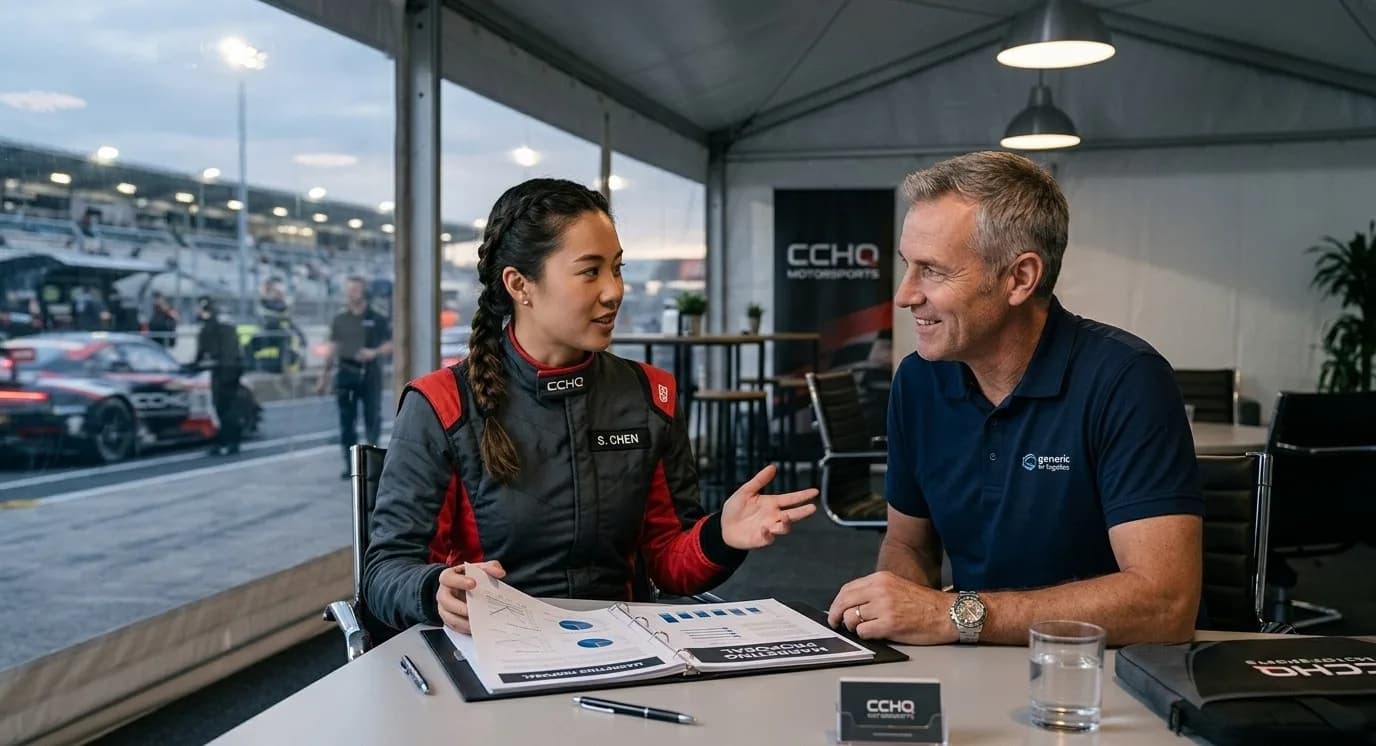
When you are ready to make contact, your presentation must scream professionalism. It is not a request; it is a business proposal. It needs specific structure.
1. The Overview (The 'Why')
Start with a compelling story. What problem are you solving? (E.g., helping a software company reach 10,000 IT professionals who also love racing). This is the hook. Make it about them, not you.
2. The Audience Breakdown (The 'Who')
Provide the data. Use screenshots of your engagement metrics. If you have an email list, show the open and click-through rates. Define the demographics of your average follower (e.g., Male, 25-40, interest in performance engineering).
3. Commercial Rights Packages (The 'What')
Don't just have one massive, single offer. Create clear tiers with defined deliverables. This shows you understand flexibility and market pricing.
Package Tier | Name | Key Assets | Example B2B Right | Pricing Strategy |
Tier 1 | Primary Partner | Main car branding, driver suit branding, logo on every asset | Full usage of driver/car imagery for all media | High (75% - 100% of program budget) |
Tier 2 | Associate Partner | Side panel logo, logo on race suit sleeve | Logo placement on corporate B2B communications | Mid (25% - 50% of program budget) |
Tier 3 | Official Supplier | (E.g., "Official Brake Fluid Sponsor") | Use of "Official Supplier of [Driver Name]" title | Low (Product / Service / 10% - 20%) |
4. The Activation Strategy (The 'How')
Propose 3-5 specific campaigns that align with the sponsor’s marketing goals. This section proves you can execute the strategy, not just sell a logo placement. E.g., a "Test-Drive Day" for their top VIP clients, using a performance driving school as the venue.
5. Measurable Outcomes (The 'ROI')
How will they know it worked? Will they measure brand awareness? Social engagement? Sales leads? Propose metrics (e.g., increase in social followers, email signup conversions from a dedicated landing page, media mentions in key publications). This is your plan for success.
Defining a Practical Sponsorship Budget
Your budget is not just your entry fee plus tires. It is the cost of running a full commercial program. A smart sponsor will spot an unrealistic or bloated budget instantly.
Include your operational costs (entry, tires, fuel, travel, crew) but also include a Marketing Activation Budget (E.g., cost of professional photography/videography, running ads on social content, hosting hospitality events). The total program budget needs to make business sense relative to the marketing value you are generating.
Negotiating Commercial Rights
When you are in the negotiation phase, keep your cool. Everything is a trade. A business might ask for the exclusive right to use your image in their next television ad campaign. If you grant that, you are locking out other potential partners in that product category. Your commercial rights have market value.
Only sell what you are ready to deliver, and define the terms of every asset placement in a written contract. It protects both you and the partner.
The Verdict: Make It Business, Not Passion
Getting a race car sponsorship is not about asking for support. It is about selling a measurable marketing asset. It is not easy, but it is straightforward. Your speed in the driver’s seat is irrelevant if you cannot prove you are just as fast with a spreadsheet and a commercial proposal.
Stop asking for help, and start building partners. That is how you get a race car sponsorship, and that is how you build a career.
Join CarCultureHQ
Claim your free digital garage
Build your ride profile, log modifications, join a crew, and get your build in front of thousands of enthusiasts.
Create your free garageFrequently asked questions
Do I need to be winning to get a race car sponsorship?
Winning helps, but it is not everything. Sponsors are attracted to a driver's brand and their ability to tell a compelling story and engage an audience. If you have a powerful driver narrative, high social engagement, and an innovative commercial plan, you can absolutely secure sponsorship even without winning every race. The value is in your influence.
How much does a professional sponsorship proposal cost to create?
A basic proposal might only cost your time, but a professional, high-end, data-driven proposal (using design software and market research) can cost anywhere from $1,500 to $5,000+ if you hire specialized agencies or consultants. It is an investment, but a high-quality proposal drastically improves your chances of closing a major deal.
Can I get sponsorship for amateur racing?
Yes, but the scope will be different. Companies might sponsors amateur programs through "In-Kind" (product) donations, local business support, or employee branding. At this level, the activation plan must focus heavily on community involvement, local press coverage, and highly defined direct-sales strategies rather than major media exposure.
What is the most common mistake drivers make when pitching?
The single most common mistake is creating a proposal focused entirely on "the driver's dream" or their need for money. To be successful, the entire pitch must be structured around the sponsor's marketing needs. The very first slide should explain the commercial benefit to their company, not how fast you will go.

Comments
Join the conversation on How to Get Race Car Sponsorship: The Hard Truth, No Bullshit Guide. Keep it civil — admins moderate reports.
Loading comments…