The Psychology of Track Fear: How to Push the Limit Without Crossing It

Every driver who has ever strapped into a harness and stared down the hot pit lane knows that sick feeling in their stomach. Track fear is not a sign of weakness; it is your brain trying to keep your car off the tire wall. This post breaks down how real drivers manage panic, read tire feedback under braking, and find their true limits without writing off their machine.
The Psychology of Track Fear: How to Push the Limit Without Crossing It
Your harness is pulled tight enough that you can barely take a deep breath. You are sitting in the hot pit lane, staring at the flagger, waiting for the arm to drop. Your hands in your racing gloves are slightly damp, and your heart is hammering against your ribs.
If you tell people you do not feel that, you are lying to them or you are about to put your car backwards into a barrier.
Track fear is real. It is the natural reaction of an animal that knows it is strapped inside an aluminum box moving at 120 miles per hour toward a solid concrete wall. The difference between drivers who get faster every season and drivers who wreck their project cars comes down to one thing: how you deal with that voice in your head.
Join CarCultureHQ
Claim your free digital garage
Build your ride profile, log modifications, join a crew, and get your build in front of thousands of enthusiasts.
Create your free garageFear Is Data, Not an Obstacle
Most amateur drivers think going faster means gritting their teeth and holding the throttle down longer. That is how you end up on a flatbed with torn-off suspension arms.
When your stomach drops coming into a heavy braking zone, that is not an emotion to suppress. It is data. Your brain is telling you that your visual processing is falling behind the speed of the car.
Instead of fighting the fear, listen to the car.
Are the front tires chattering under trail braking?
Is the rear end feeling floaty over the curbing?
Did the brake pedal get a quarter-inch softer on the last lap?
When you shift your attention from the risk of crashing to the mechanical reality of what the chassis is doing, the panic disappears. You stop reacting to fear and start reacting to grip.
The Danger of the Red Mist
We have all seen it happen on a track day. A driver gets passed by a lower-powered car, their ego takes a hit, and their driving falls apart in two corners. Their hands get jerky on the wheel, they stomp the throttle mid-corner before the car takes a set, and they blow past their braking zone.
The stopwatch does not care how hard you are trying. It only measures how efficiently you roll speed through an apex. The moment your inputs turn sharp and aggressive, you overload the tire contact patch.
If you feel your temper flaring or your breathing getting short, take one cool-down lap. Back off twenty percent. Reset your eyes on the horizon, let the brakes shed heat, and build your rhythm back up from scratch.
Creeping Up on the Edge
The safest and fastest way to find the limit is what track coaches call creeping.
If you brake at the three-hundred-foot marker into turn one, you do not jump straight to the one-hundred-foot board on the next lap just to see what happens. You brake at two-hundred and eighty feet. You feel how the car rotates. You check how much track width you have left on exit.
When you increase your commitment in small, predictable increments, you give yourself room to catch a slide before it turns into a spin.
Every lap provides feedback. If you hit your clipping point cleanly and have half a car width of unused track on the outside, you know you have room to carry three more miles per hour on the next pass. That is calculated progression, not blind bravery.
Respect the Machine, Respect the Track
Confidence does not come from pretending you cannot crash. It comes from knowing that your car is mechanically sound and that you are driving within your current skill level.
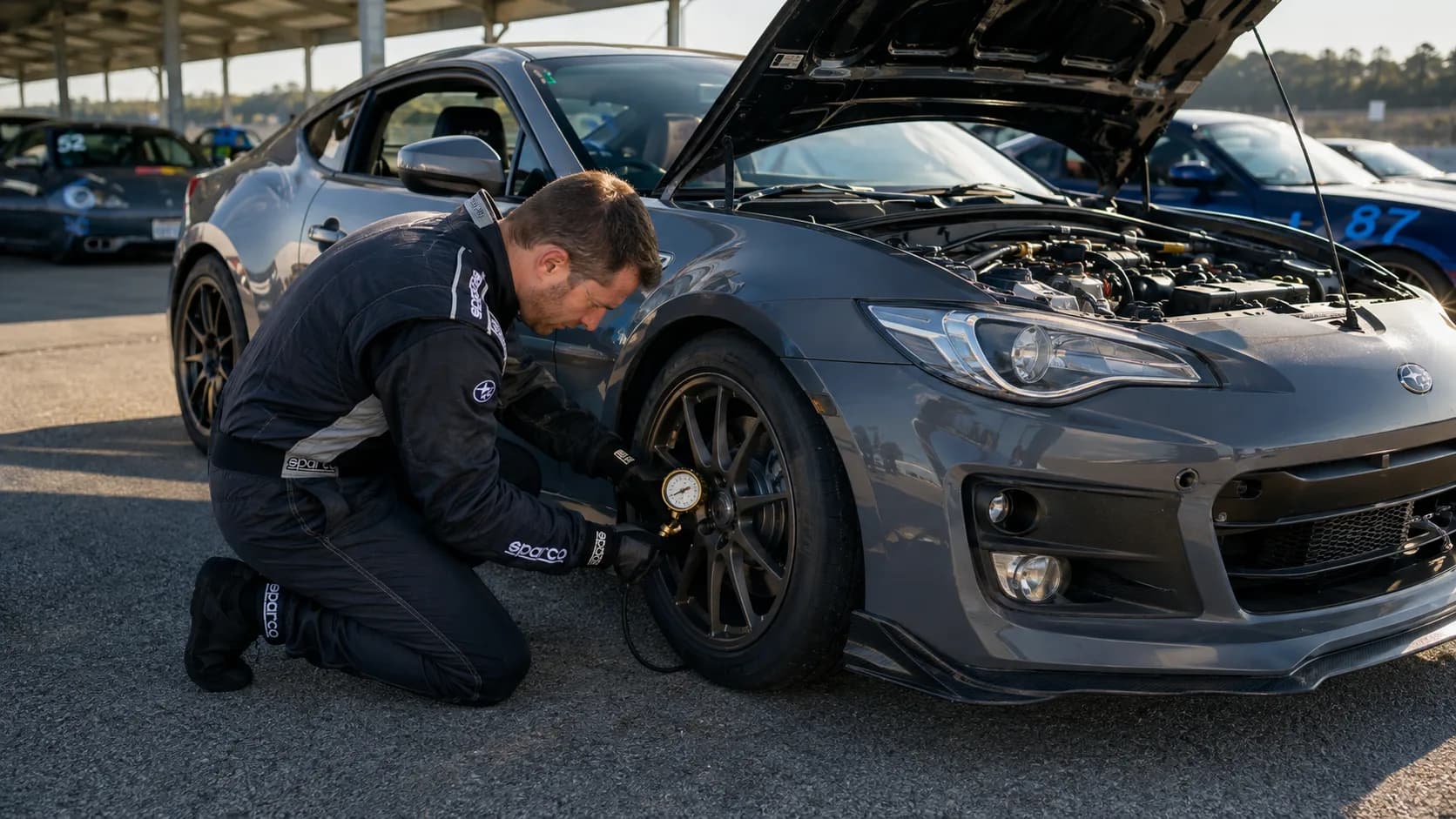
Check your lug torque between sessions. Monitor your tire pressures when you pull off the circuit. Keep an eye on fluid temps. When you know your machine is dialed and you treat the track with respect, the anxiety turns into sharp, quiet focus.
You do not need to prove anything on your out lap. The drivers who stay in this hobby for decades are the ones who know how to park their ego in the paddock, listen to their car, and drive home in one piece at the end of the day.
Join CarCultureHQ
Claim your free digital garage
Build your ride profile, log modifications, join a crew, and get your build in front of thousands of enthusiasts.
Create your free garageFrequently asked questions
How do I get rid of nervousness before my first track session?
You do not eliminate it; you manage it. Do a thorough pre-track safety check on your lugs, brakes, and fluids. Take your first three laps at sixty percent pace to learn the line and warm up your tires before pushing.
What is the most common mistake drivers make when trying to go faster?
Overdriving corner entry. Drivers frequently brake too late, carry too much speed into the corner, push wide, and ruin their exit speed down the following straight.
How do I know when I am close to the car's grip limit?
Listen and feel for tire scrub and steering weight. As a tire nears its grip threshold, the steering will lighten slightly, and the tires will produce a low scrub sound before breaking away into a full slide.
Should I turn off traction control on track days?
No, not until you have extensive seat time and consistent car control skills. Modern performance stability systems allow you to explore vehicle dynamics safely without snapping into a spin when you make a minor mistake.


Comments
Join the conversation on The Psychology of Track Fear: How to Push the Limit Without Crossing It. Keep it civil — admins moderate reports.
Loading comments…