SEMA’s Golden Era: How Las Vegas Built the Aftermarket Spectacle
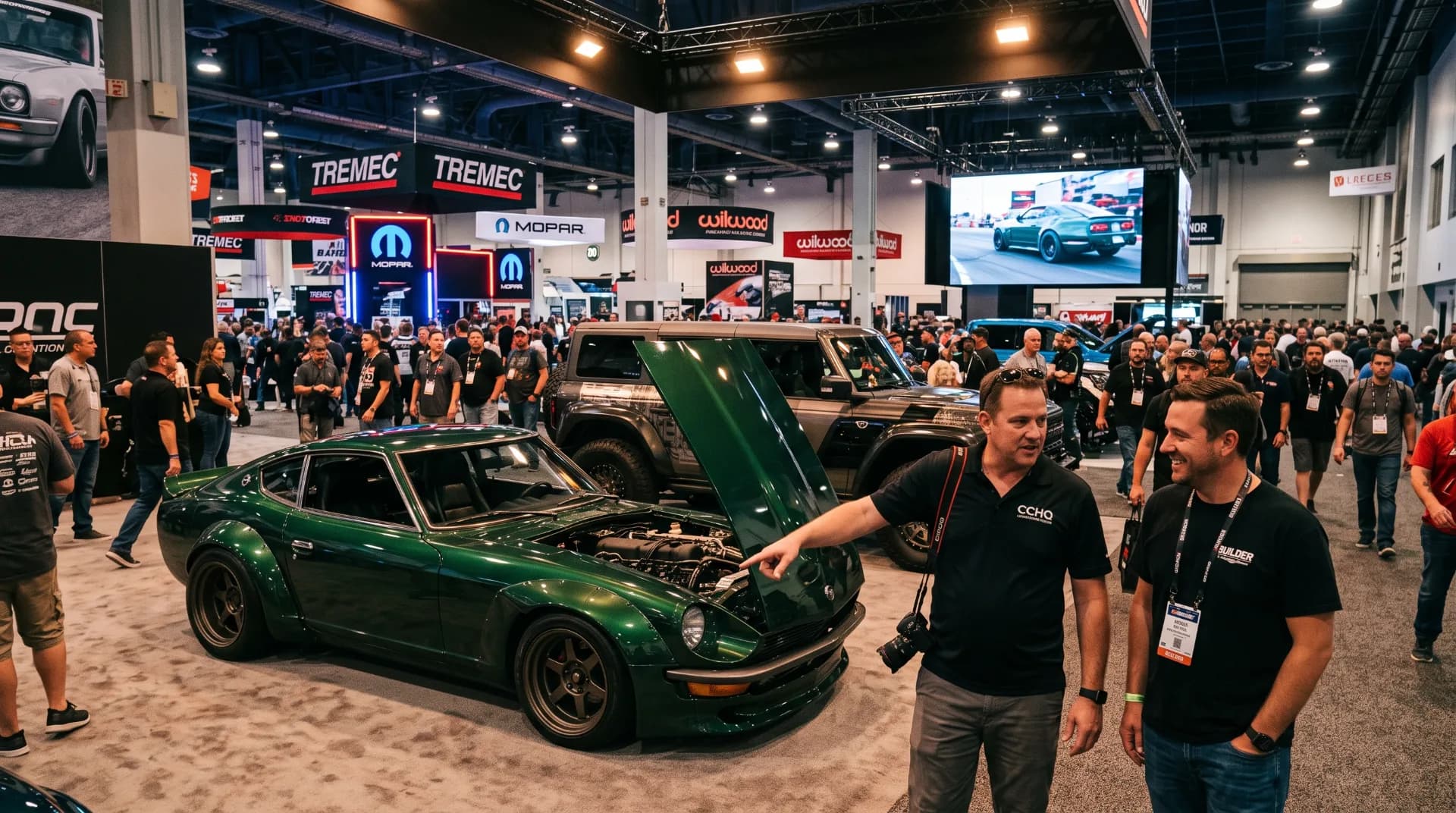
The SEMA Show started as a basement-level trade gathering for hot rodders and turned into a sensory-overload spectacle on the Las Vegas strip. This is the unvarnished story of how the aftermarket grew up, cashed in, and took over the automotive world.
SEMA’s Golden Era: How Las Vegas Turned the Aftermarket into a Global Spectacle
If you have ever walked the floor of the Las Vegas Convention Center in early November, you know the physical toll it takes. Your feet throb through thick soles, your ears ring from air horns and straight-piped V8s firing up in closed halls, and your eyes burn under millions of square feet of harsh fluorescent light.
It is loud, chaotic, exhausting, and completely unmatched anywhere else on earth.
SEMA today looks like a carnival of high-dollar builds, celebrity appearances, and carbon-fiber excess. But it did not start under neon lights with OEM multi-million-dollar budgets. It started in the dirt, wrenching on flatheads, trying to convince the world that modifying a car was an art form worth paying for.
Join CarCultureHQ
Claim your free digital garage
Build your ride profile, log modifications, join a crew, and get your build in front of thousands of enthusiasts.
Create your free garageThe Dodger Stadium Basement Days
Back in 1967, the Specialty Equipment Market Association was just five guys with grease under their fingernails wanting a legitimate way to sell speed equipment. The first event took place in the basement concourse of Dodger Stadium in Los Angeles.
There were roughly 98 booths and about 3,000 attendees. It was purely business:
Speed shops meeting machine operators.
Engine builders showing off intake runners and custom cams.
Mechanics trading blueprints over cheap coffee.
No influencers. No neon-lit tire displays. Just builders trying to survive and keep the hot rod flame burning post-war.
Moving to the Desert: The Big Gamble
By 1977, the show outgrew California and rolled the dice on Las Vegas. The timing was perfect.
Las Vegas offered the one thing the growing aftermarket desperately needed: limitless square footage and an appetite for theatrical presentation. The Vegas Convention Center allowed booths to transform from simple tables into full-blown custom garages.
Suddenly, builders were not just bringing boxed parts; they were bringing entire completed vehicles to prove what those parts could do on asphalt. That shift changed everything. SEMA stopped being a swap meet for retailers and evolved into the premier runway for custom automotive design.
When the Automakers Finally Showed Up
For decades, big manufacturers viewed the aftermarket with open suspicion. Modifying an engine meant voiding a warranty. Custom suspension meant you were ruining factory engineering.
Then the 1990s and early 2000s hit. Ford, GM, Toyota, and Honda realized that SEMA was where the genuine passion lived. They stopped fighting the aftermarket and started handing pre-production chassis directly to elite builders months before public release.
When OEMs bought in, the floodgates opened:
Concept cars shared carpet with grassroots drift machines.
Crate motors became plug-and-play realities for home garage mechanics.
Trends born at SEMA on Tuesday became factory trim packages three years later.
The Modern Golden Era: Art, Clout, and Pure Metal
SEMA has had its growing pains. The rise of social media created the infamous "SEMA Crunch," where shops pull sleepless 90-day benders to build trucks with unpainted frames and cars held together by zip ties just to hit the Tuesday morning deadline.
Yet behind the glitz and the clout chasers, the core remains untouched. Walk through the Central Hall or out past South Hall into the tire smoke of the drift demos, and you see the finest metal fabrication on the planet. You see painters who treat sheet metal like the Sistine Chapel and tuners extracting four-digit horsepower from three-cylinder engines.
SEMA proved that car culture could not be contained in local garages. Las Vegas gave it a global megaphone, and the aftermarket has never looked back.
Join CarCultureHQ
Claim your free digital garage
Build your ride profile, log modifications, join a crew, and get your build in front of thousands of enthusiasts.
Create your free garageFrequently asked questions
Can the general public attend the SEMA Show?
SEMA is strictly a trade-only industry event open to automotive professionals, media, and exhibitors. However, SEMA Fest and SEMA Ignited allow the general public to view builds and experience automotive entertainment at the conclusion of the show.
What is the SEMA Crunch?
The SEMA Crunch is the chaotic period in the weeks and months leading up to November when builder shops work around the clock with little sleep to finish custom builds in time for their booth roll-in deadlines.
Why is SEMA held in Las Vegas?
Las Vegas provides the massive convention floor space, logistics, and hotel infrastructure required to host over 150,000 automotive industry professionals and thousands of display vehicles every year.
How does SEMA impact everyday car enthusiasts?
Parts unveiled at SEMA dictate what ends up on consumer shelves, from bolt-on turbochargers and suspension kits to wheel designs and interior electronics that everyday builders use in their home garages.
Comments
Join the conversation on SEMA’s Golden Era: How Las Vegas Built the Aftermarket Spectacle. Keep it civil — admins moderate reports.
Loading comments…