Understanding Scrub Radius: How Offset and Spacers Ruin Steering
Written and reviewed by the CarCultureHQ Editorial Team. See our Editorial Policy for sourcing and corrections.
Estimated Read Time: 10 minutes
Summary: Most people buy wider wheels or slap on thick spacers for aggressive flush fitment without thinking twice about suspension geometry. But pushing your wheels outward directly changes your scrub radius, the distance on the ground between your steering axis and tire center line. Here is what happens to your steering feedback, tramlining, and braking stability when you mess with factory offset.
The Price of Flush Fitment
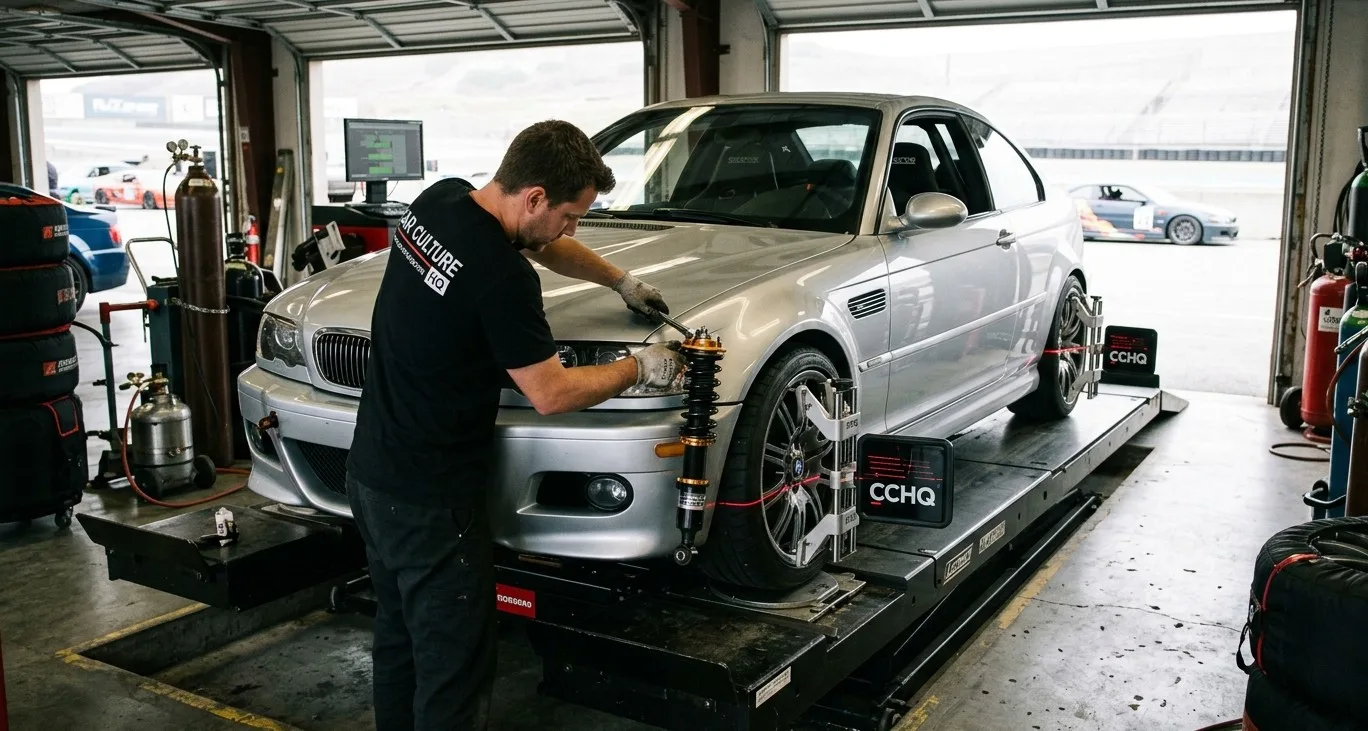
You see it in garage bays and parking lots every weekend. Someone picks up a clean performance chassis, drops it on coilovers, and immediately orders 20mm bolt-on spacers or ultra-low-offset wheels to push the lips flush with the fender arches. The car looks aggressive sitting static. Then they take it out on a cracked back road, and the steering wheel starts fighting back over every seam in the asphalt.
That erratic steering behavior isn't a mystery. It is basic suspension geometry.
When engineers design a front suspension, they establish a precise mechanical relationship between where the wheel pivots and where the tire meets the road. Pushing the wheel center line outward changes that relationship completely. That measurement is called scrub radius, and understanding it is the difference between a car that drives with razor-sharp feedback and one that feels like a chore to keep in a straight line.
Join CarCultureHQ
Claim your free digital garage
Build your ride profile, log modifications, join a crew, and get your build in front of thousands of enthusiasts.
Create your free garageWhat Scrub Radius Actually Is
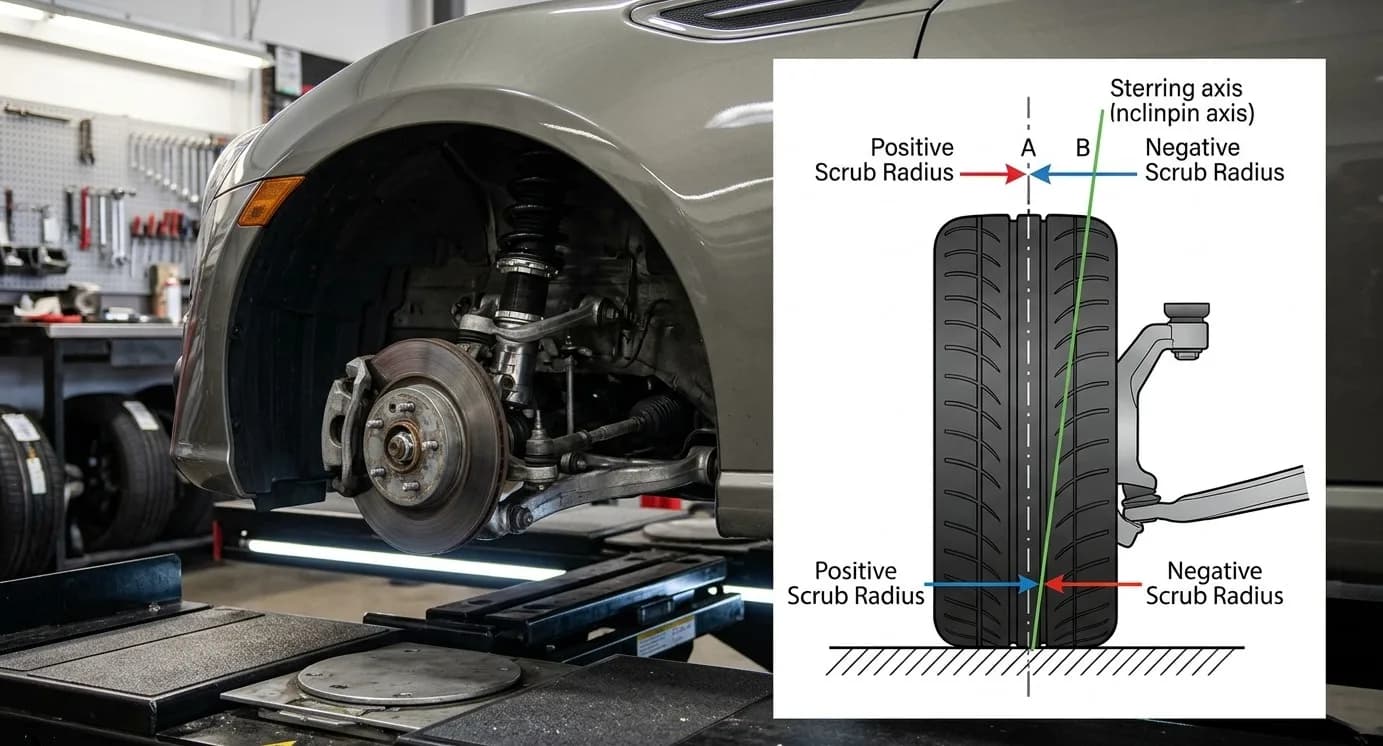
Imagine drawing an invisible straight line down through your front suspension's upper and lower pivot points. On a MacPherson strut car, that line runs from the top strut mount straight through the lower ball joint down to the road. On a double-wishbone setup, it passes through the upper and lower ball joints. This line is called the Steering Axis or Kingpin Axis.
Where that line hits the pavement is Point A.
Now draw a second line vertically down through the dead center of your tire's contact patch. Where that line hits the pavement is Point B.
The distance between Point A and Point B on the ground is your scrub radius.
The Three Types of Scrub Radius
Zero Scrub Radius: The steering axis line hits the ground at the exact center of the tire contact patch. Turning the wheel pivots the tire in place like a turntable.
Positive Scrub Radius: The steering axis line hits the ground inside the center of the tire contact patch. The tire sits further out than the pivot line.
Negative Scrub Radius: The steering axis line hits the ground outside the center of the tire contact patch. The tire sits further in than the pivot line.
How Offset and Spacers Shift Your Geometry
When you bolt on a wheel with a lower offset (for example, moving from a factory +45mm to an aftermarket +25mm) or throw a 20mm spacer behind your stock hub, you physically push the center of the tire outward by 20 millimeters.
The steering axis, which is defined by your hard suspension mounting points, stays in the exact same spot.
By moving the tire center outward while the pivot line stays fixed, you move your scrub radius further into positive territory. If your car started with a neutral or small positive scrub radius from the factory, that 20mm change creates a massive lever arm on the ground.
Wheel Change | Effect on Tire Centerline | Effect on Scrub Radius | Driver Impact |
Lower Offset (e.g., +45 to +25) | Moves outward 20mm | Increases positive scrub | Heavier turn-in, higher kickback |
Adding Bolt-On Spacers (15mm-25mm) | Moves outward 15mm-25mm | Increases positive scrub | Increased tramlining, unstable braking |
Higher Offset (e.g., +35 to +45) | Moves inward 10mm | Increases negative scrub | Muted steering feel, reduced self-centering |
Wider Wheel (Same Offset) | Expands equally inward/outward | Zero change to center line | Unchanged scrub radius, higher load |
The Real-World Steering Consequences
Messing with your scrub radius changes how road forces transfer through the knuckles, tie rods, and steering rack into your hands. Here is what happens on the road when positive scrub gets out of hand.
Factory Alignment Baseline | Excessive Positive Scrub Radius |
Tracks straight over road seams | Follows ruts and grooves (tramlines) |
Smooth, predictable kickback | Harsh steering wheel wheel-fight |
Stable straight-line hard braking | Car pulls toward high-grip side |
Natural wheel self-centering | Heavy, unnatural steering weight |
1. Severe Tramlining
Ever drive down a rutted highway lane and feel the front end darting around like it is hunting for a groove? That is tramlining. When you widen your positive scrub radius, road ruts apply leverage to the outer edge of the tire contact patch. Because the tire sits further away from the pivot line, that road force easily turns the front wheels without your input.
2. Harsh Steering Kickback
Hit a pothole, expansion joint, or rumble strip mid-corner with excessive positive scrub, and the impact hits the tire off-center from the steering axis. That creates a sudden twisting force around the spindle. Instead of the suspension absorbing the vertical blow smoothly, that force gets transmitted straight through the tie rods into the steering wheel, snapping it in your hands.
3. Unstable Hard Braking
Negative scrub radius is engineered into many modern passenger cars specifically for braking safety. If you hit a patch of ice, wet pavement, or loose gravel with your left front tire while braking hard, the right front tire has far more grip.
With negative scrub, the braking drag on the right tire creates a natural counter-steering force that keeps the car tracking straight. With heavy positive scrub, that same braking drag pulls the vehicle violently toward the side with traction, forcing you to fight the steering wheel to stay in your lane.
Front-Wheel Drive vs. Rear-Wheel Drive Dynamics
Factory engineers choose scrub radius based on drivetrain configuration and electronic driver aids.
Front-Wheel Drive (FWD)
Most FWD performance cars run negative scrub radius from the factory. Because engine torque is driving the front wheels, acceleration forces try to pull the tires forward. Negative scrub creates an opposing inward force that cancels out torque steer and keeps the steering wheel stable during hard comma exits.
When you put aggressive spacers on a FWD hot hatch, you push it into positive scrub, exposing all the torque steer the factory engineers worked hard to eliminate.
Rear-Wheel Drive (RWD)
RWD performance cars frequently run a small amount of positive scrub radius. This gives the driver direct tactile feedback about front tire grip levels and provides a natural self-centering feel as you unwind the steering wheel out of a corner.
However, "a small amount" is the key phrase. Moving from 5mm of factory positive scrub to 30mm of positive scrub through low-offset wheels doesn't give you "better feel." It just overloads the rack with mechanical noise.
Practical Setup Rules for the Garage
You don't need to avoid aftermarket wheels or minor fitment adjustments entirely. The key is staying within reasonable geometric boundaries so your car continues to drive well.
Keep Offset Changes Small: Aim to stay within 5mm to 10mm of your factory wheel offset whenever possible. If your stock wheels are +45mm, running a +35mm wheel gives you a cleaner flush look without ruining steering geometry.
Add Rim Width, Don't Just Drop Offset: If you want a wider tire contact patch, increase the wheel width while adjusting offset to keep the tire centerline close to factory specs. A wider wheel with correct offset maintains your scrub radius far better than a narrow wheel pushed out with a massive spacer.
Correct Camber Thoughtfully: Increasing negative camber via top strut mounts tilts the entire steering axis inward, which slightly alters scrub radius. Using lower eccentric crash bolts shifts the knuckle relative to the strut, changing geometry differently. If you are tuning for track use, balance camber adjustments with wheel selection.
Test Before Committing: If you are adding spacers to clear aftermarket big brake kits, buy inexpensive test spacers first. Drive the car on a bumpy, familiar road to evaluate steering feedback before buying custom-forged wheels with aggressive offsets.
The Final Verdict on Fitment vs. Physics
There is nothing wrong with wanting your car to look right on the street or the paddock. But static stance should never come at the expense of chassis control. Pushing your wheels out 25 millimeters with thick spacers might win compliments in a parking lot, but if it turns your steering wheel into a unpredictable, tramlining mess on a back road, you have degraded the machine.
Measure your offsets, keep your scrub radius changes within a sane window, and prioritize steering feedback over extreme flush fitment. A car that tracks straight, brakes predictably, and communicates cleanly through the steering wheel will always be more satisfying to drive fast than one modified strictly for a camera angle.
Join CarCultureHQ
Claim your free digital garage
Build your ride profile, log modifications, join a crew, and get your build in front of thousands of enthusiasts.
Create your free garageFrequently asked questions
Will wider tires change my scrub radius if I keep the same wheel offset?
No. Widening the tire expands the contact patch equally on both the inside and outside edges. Because the center line of the tire stays in the exact same spot relative to the hub mounting face, your scrub radius measurement remains identical. However, the wider contact patch will increase overall steering effort and mechanical grip.
Can an alignment shop fix scrub radius issues caused by wheel spacers?
Not directly. Standard alignment adjustments like toe and camber cannot move the wheel mounting face back toward the vehicle center line. While adding negative camber via adjustable top mounts moves the top of the steering axis, it does not compensate for a 20mm spacer pushed out at the hub. The only real fix for incorrect scrub radius is changing wheel offset or reducing spacer thickness.
Why do some race cars run large positive scrub radius setups?
Dedicated race cars built for glass-smooth circuits sometimes run positive scrub to give the driver heavy, direct feedback through unassisted steering racks. On a smooth track without ruts or potholes, the downsides of positive scrub (tramlining and kickback) are minimal, while the immediate steering resistance helps the driver gauge front tire slip angles.
Are wheel spacers safe for street and track driving?
Quality hub-centric spacers made from high-grade aluminum with properly lengthened wheel studs or hardened lug bolts are mechanically safe when torqued correctly. The safety risk rarely comes from the spacer breaking; it comes from the degraded handling stability, increased wheel bearing wear, and altered scrub radius caused by pushing the wheel center line too far out.
Comments
Join the conversation on Understanding Scrub Radius: How Offset and Spacers Ruin Steering. Keep it civil — admins moderate reports.
Loading comments…