Supercharger vs Turbo vs ProCharger: Which Is Better?
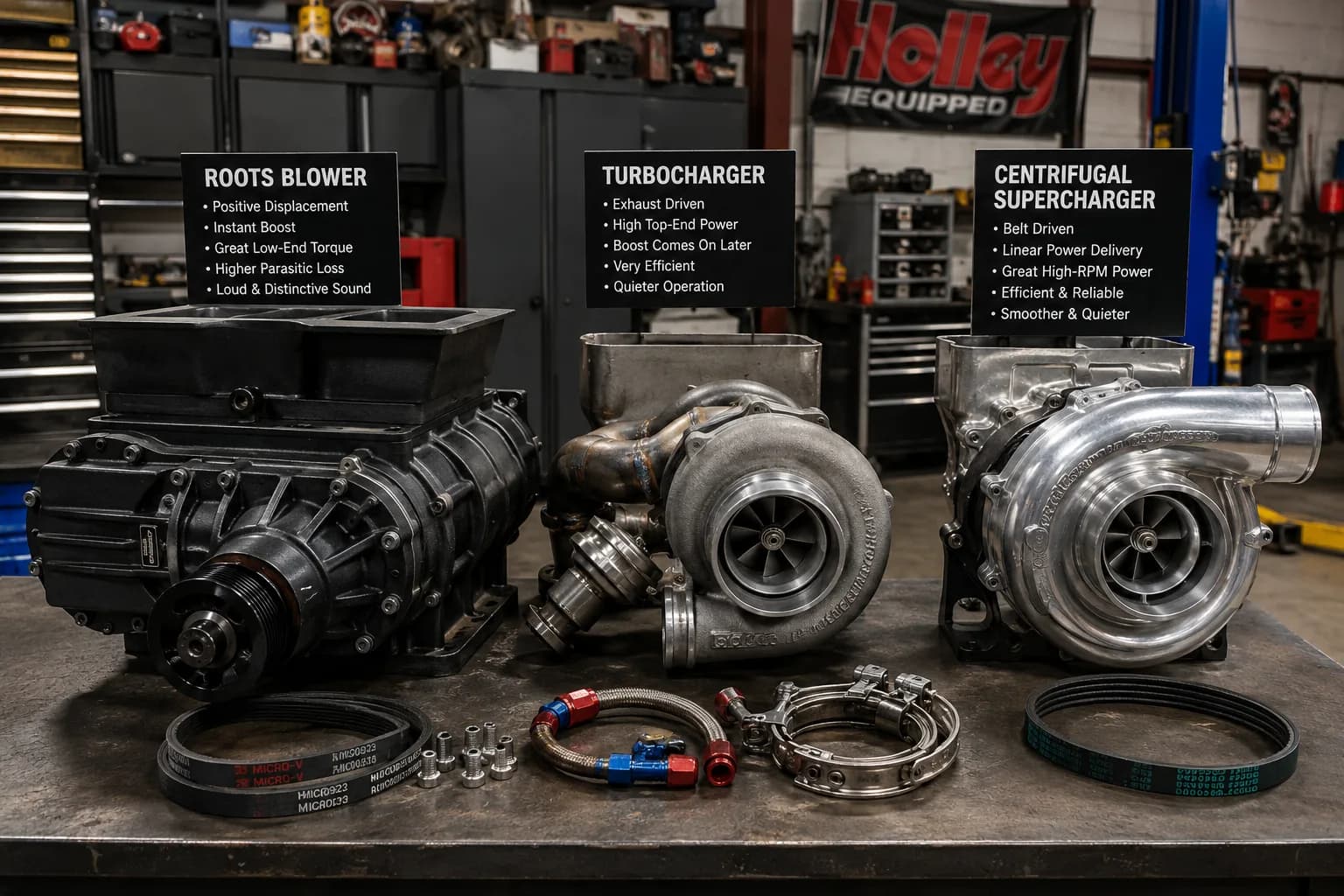
Choosing between a roots supercharger, a turbocharger, and a centrifugal supercharger comes down to how you want power delivered to your rear wheels. We break down boost response, engine bay heat, parasitic drag, and installation headaches so you can pick the right forced induction setup for your build.
Beyond the Dyno Sheet: Choosing Your Boost
Go to any car show or browse CCHQ build logs, and you will see people arguing about forced induction until they are blue in the face.
Most internet debates focus purely on peak numbers. Someone posts an 800-horsepower dyno graph, and everyone assumes that setup is superior.
Peak horsepower numbers tell you almost nothing about how a car feels when you step on the gas at 2,500 RPM on a back road or exit a tight corner on track. Power delivery curve, belt slip, underhood heat, and mechanical complexity dictate how much you will actually enjoy driving your car. Here is how all three boost options perform in the real world.
Join CarCultureHQ
Claim your free digital garage
Build your ride profile, log modifications, join a crew, and get your build in front of thousands of enthusiasts.
Create your free garageRoots and Twin-Screw Superchargers: Instant Low-End Grunt
Positive displacement blowers sit directly on top of your intake manifold. When you step on the pedal, they force a fixed volume of air into the cylinders instantly.
Why builders run them: Instant throttle response. You do not wait for exhaust gas to build or RPMs to climb. The moment you touch the gas, you get full boost and instant torque. This makes them incredible for heavy street cars, V8 muscle, and daily drivers where you want immediate power.
The drawback: Heat soak and parasitic loss. Turning a heavy internal rotor assembly with an engine belt steals power directly from the crankshaft. Furthermore, compressing air right on top of the engine block traps heat, causing power to drop during repeated hot laps.
Turbochargers: Pure Efficiency and Scalable Power
Turbos use waste exhaust gas to spin a turbine wheel, which drives a compressor wheel to force air into the engine.
Why builders run them: Free energy and huge top-end power. Because turbos rely on exhaust pressure instead of a crankshaft belt, they do not create mechanical parasitic drag on the engine. They offer the highest power potential per engine displacement and allow you to adjust boost levels on the fly with an electronic controller.
The drawback: Lag and plumbing complexity. You have to wait for exhaust volume to spool the turbine. Plus, routing exhaust manifolds, downpipes, intercooler piping, oil feed lines, and wastegates creates a crowded engine bay with dozens of potential leak points.
Centrifugal Superchargers: The High-RPM Specialist
Centrifugal blowers (commonly referred to by brand names like ProCharger or Vortech) use an internal gear drive to spin a turbo-style compressor wheel via an engine belt.
Why builders run them: Linear power delivery and easy installation. They mount to the front of the engine like a standard accessory, keeping intake air temps lower than a top-mount roots blower. Power builds smoothly as RPM rises, making traction easier to manage off the line and coming out of corners.
The drawback: Weak low-end torque. Because centrifugal units rely on engine RPM to spin the internal impellor, boost builds exponentially. If you hit the gas at 2,000 RPM, you get very little boost compared to what the car delivers at 6,000 RPM.
Heat, Belts, and Maintenance Reality
Before you drop money on a forced induction kit, consider what it takes to keep the car running reliably season after season:
Belt Tension and Slip: Both roots and centrifugal superchargers place immense stress on your front accessory drive. High boost levels require heavy-duty tensioners and wider 8-rib or 10-rib belts to prevent slipping under load.
Exhaust Heat Management: Turbos concentrate massive thermal energy inside the engine bay. You need high-quality turbo blankets, ceramic coatings, and heat shielding to keep nearby brake lines, wiring looms, and sensors from melting.
Traction Control via Footwork: Instant-torque roots blowers tear tires loose easily at low speeds. Centrifugal blowers and turbos let you roll into the throttle more predictably, which helps keep power planted to the road.
Join CarCultureHQ
Claim your free digital garage
Build your ride profile, log modifications, join a crew, and get your build in front of thousands of enthusiasts.
Create your free garageFrequently asked questions
Is a ProCharger considered a supercharger or a turbo?
A ProCharger is a centrifugal supercharger. It uses a centrifugal compressor housing similar to a turbocharger, but it is belt-driven by the engine crankshaft rather than powered by exhaust gas.
Which forced induction setup is easiest to install?
Centrifugal superchargers and bolt-on roots supercharger kits are generally easier to install than turbo systems because they do not require custom exhaust manifold fabrication, scavenging oil pumps, or complex hot-side piping.
Does a supercharger hurt fuel economy more than a turbo?
Yes. Because superchargers are mechanically driven by the engine belt continuously, they create constant parasitic drag on the engine even when you are not under heavy acceleration, resulting in slightly lower fuel economy during normal cruising.
Which setup is best for track day driving?
Centrifugal superchargers and properly sized small-frame turbos work exceptionally well on road courses because their linear power delivery makes throttle modulation predictable through turns without upsetting chassis balance.
Comments
Join the conversation on Supercharger vs Turbo vs ProCharger: Which Is Better?. Keep it civil — admins moderate reports.
Loading comments…