Turbo vs Procharger: How to Choose the Right Forced Induction Setup
Written and reviewed by the CarCultureHQ Editorial Team. See our Editorial Policy for sourcing and corrections.
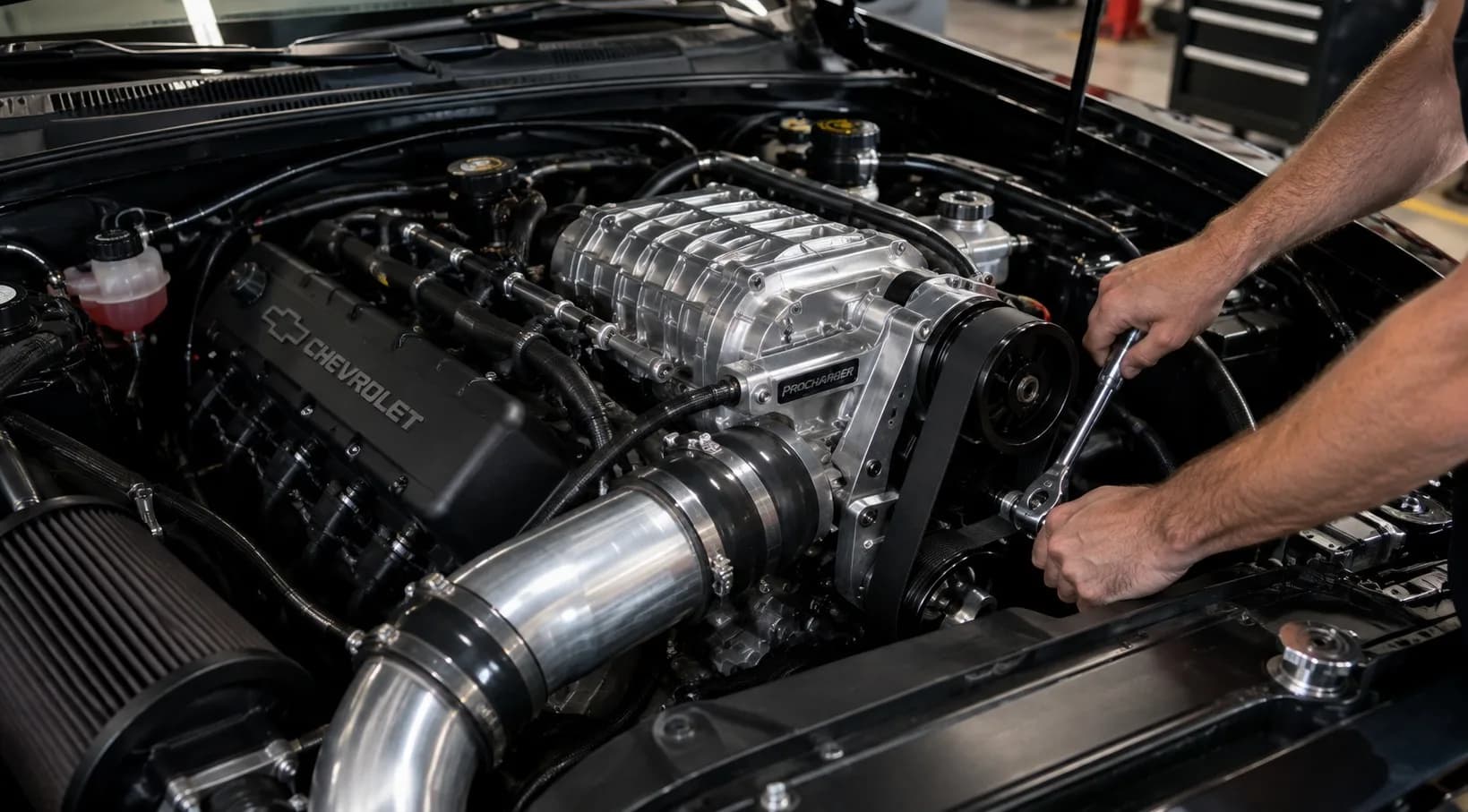
Summary: Choosing between a turbocharger and a centrifugal supercharger like a Procharger comes down to how you want your car to make power and how much plumbing you are willing to stuff under the hood. Turbos recycle waste exhaust energy to deliver massive mid-range torque, but they demand complex manifold routing and strict heat management. Prochargers run off the engine crank pulley, giving you linear power that builds with RPM without the heat headache or complex exhaust fabrication.
Free Power vs Belt Driven Reality
People love to say turbos give you free horsepower. The logic sounds clean: you take hot exhaust gas that would normally shoot out the tailpipe and use it to spin a compressor wheel.
In the real world, nothing is free. Turbos create exhaust backpressure. That backpressure works against your pistons on the exhaust stroke, creating a parasitic loss of its own.
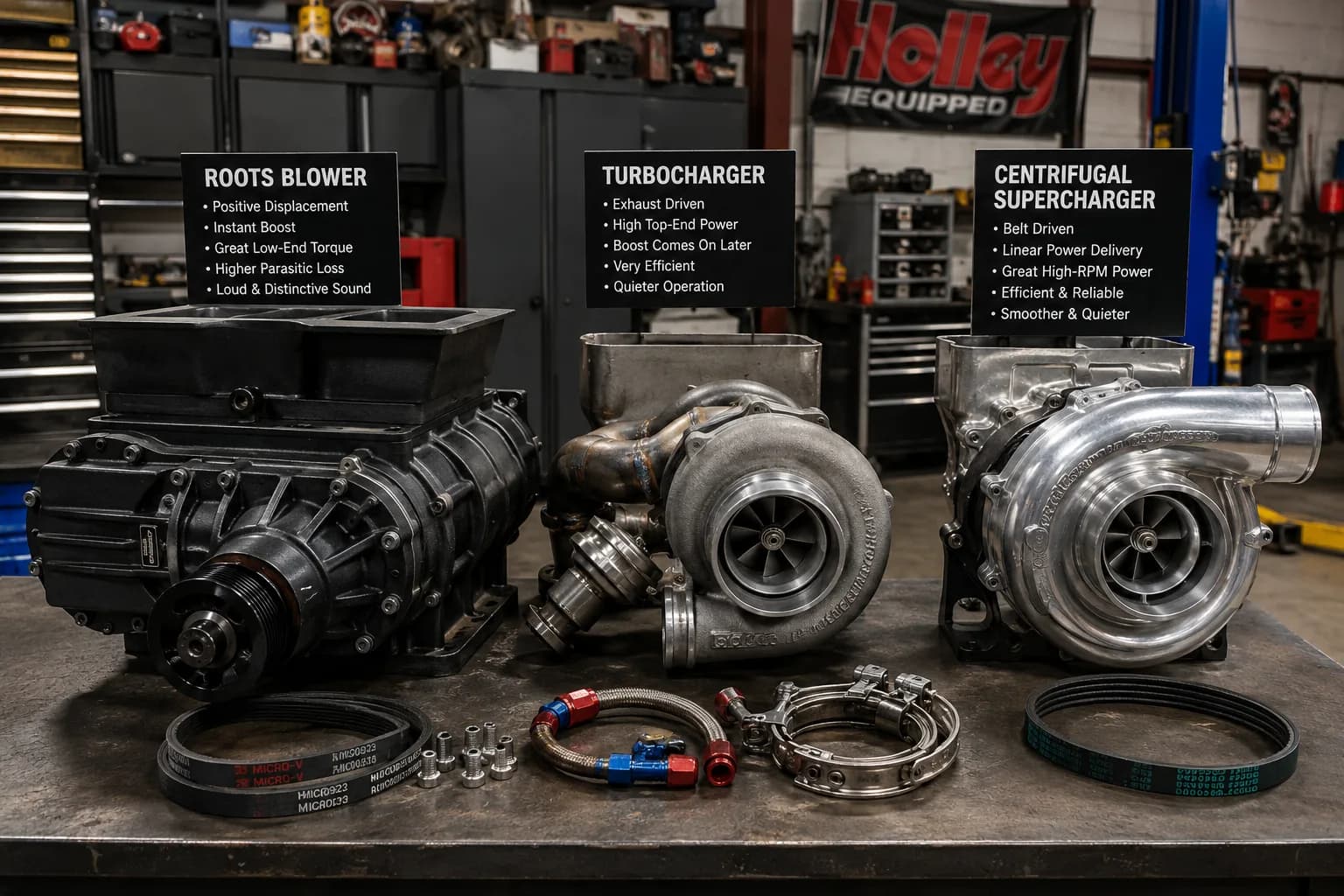
A Procharger is a centrifugal supercharger. It looks like the compressor housing of a turbo, but instead of an exhaust turbine spinning the wheel, a belt driven off your crankshaft turns internal gears.
FORCED INDUCTION CHARACTERISTICS | |
|---|---|
Drive Source | Turbo: Exhaust gas pressure and velocity. Procharger: Crankshaft belt drive via gear step-up. |
Power Curve | Turbo: Steep torque spike in mid-range. Procharger: Linear climb directly tied to RPM. |
Thermal Load | Turbo: Very High. Exhaust manifolds hold massive heat. Procharger: Moderate. Keeps factory exhaust setup. |
Boost Adjustments | Turbo: Wastegate spring or electronic controller. Procharger: Mechanical pulley swap and belt length. |
Join CarCultureHQ
Claim your free digital garage
Build your ride profile, log modifications, join a crew, and get your build in front of thousands of enthusiasts.
Create your free garageBecause a Procharger relies on crank RPM, it takes engine power to make engine power. The trade-off is simplicity and instant response without waiting for exhaust gas to build pressure.
Power Delivery on Street, Strip, and Circuit
How a car makes power matters far more than the peak number printed on a dyno sheet.
The Turbo Experience
Floor the throttle in a turbo car at 2,500 RPM. For a second, not much happens. Then, as exhaust velocity climbs, the turbine accelerates, boost hits the intake manifold, and the rear tires break traction hard.
That mid-range wallop makes a street car feel exceptionally fast. But on a road course or a tight mountain road, that sudden torque spike can break rear-tire traction mid-corner if you tap the gas a fraction of a second too early.
The Procharger Experience
A centrifugal supercharger feels like a big-block naturally aspirated motor. At 2,000 RPM, it makes minimal boost. By 4,000 RPM, it wakes up. At 6,500 RPM, it pulls like a freight train.
Because power correlates directly to engine speed, your right foot acts like a precise volume knob. You can feed power smoothly out of an apex without worrying about a sudden surge of boost shocking the chassis.
Underhood Packaging and Heat Management
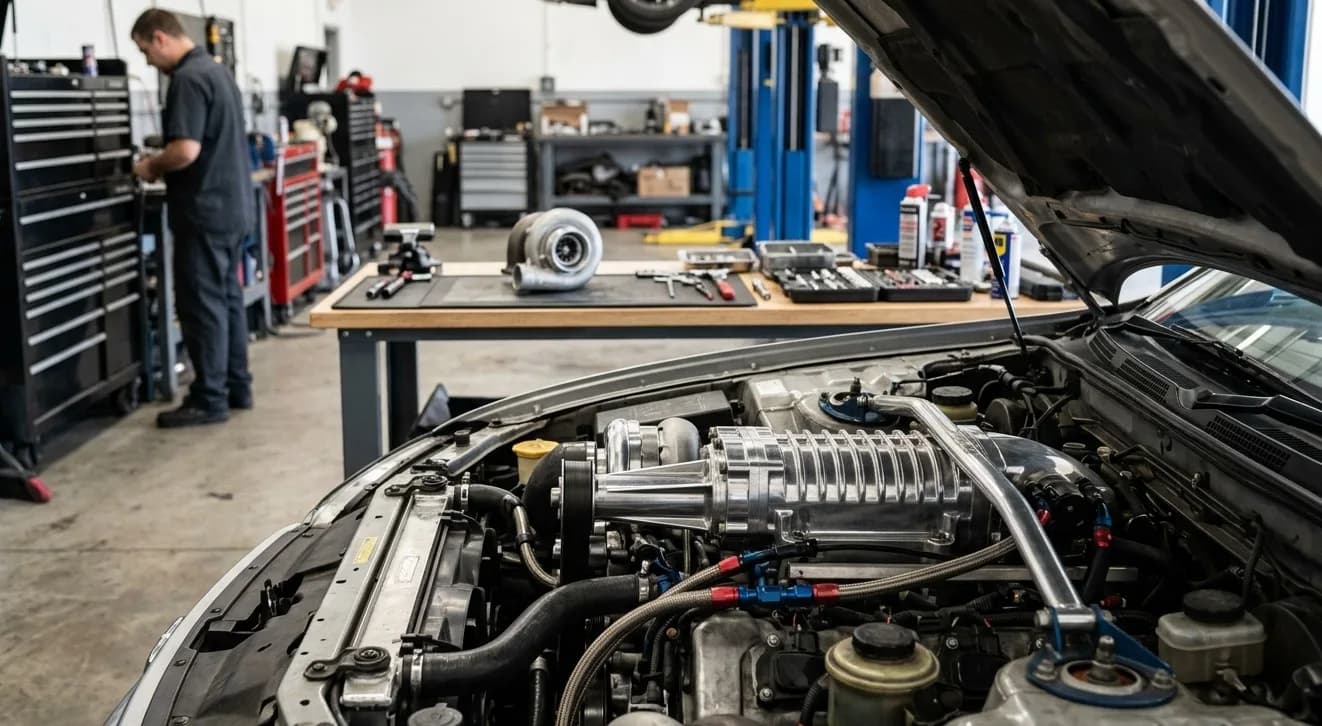
Installing forced induction into a modern engine bay is an exercise in managing space and heat.
Plumbing a Turbo System
A proper turbo installation requires:
Custom exhaust headers or hot-side crossovers.
Wastegates to dump excess exhaust pressure.
Blow-off valves to handle closed-throttle pressure spikes.
Oil feed and drain lines tapped into the engine block or pan.
Extensive heat wrapping to protect wiring harnesses, brake lines, and paint.
If you daily drive a turbo car in summer traffic, ambient engine bay temperatures get hot fast. Without proper heat shielding, plastic connectors cook and rubber hoses degrade quickly.
Installing a Procharger System
Procharger built its reputation on complete bolt-on kits. The compressor mounts to a heavy-duty bracket on the front of the engine. Exhaust manifolds remain completely stock.
You do not need to route hot exhaust pipes past steering shafts or tap oil pans if you choose a self-contained oiling model. The installation is cleaner, takes fewer hours in the garage, and leaves underhood temperatures far cooler.
What It Costs to Do It Right
Do not fall into the trap of comparing kit prices on a website. The sticker price on a box of parts represents roughly half of your final bill.
If a quality Procharger kit costs $6,500, expect to spend another $3,000 to $5,000 on supporting hardware:
Upgraded fuel injectors and high-flow fuel pump.
Professional dyno tuning time.
Upgraded clutch or automatic transmission cooler.
Catch cans and crankcase ventilation upgrades.
Pick the Character That Fits Your Drive
The debate over a turbo vs procharger isn't about which technology is superior on paper. It comes down to what you expect when you step on the gas.
If you want massive mid-range torque, variable boost control, and do not mind the fabrication work and heat management that comes with exhaust plumbing, build a turbo setup.
If you want immediate throttle response, a linear power curve that pulls hard to redline, and a straightforward installation process that keeps your factory exhaust intact, bolting on a Procharger is hard to beat.
Join CarCultureHQ
Claim your free digital garage
Build your ride profile, log modifications, join a crew, and get your build in front of thousands of enthusiasts.
Create your free garageFrequently asked questions
Does a Procharger have lag?
No. Centrifugal superchargers are driven directly by the engine crankshaft via a belt. There is no lag or spool time waiting for exhaust gas. Boost pressure rises smoothly and instantly as engine RPM increases.
Which is better for a daily driver, turbo or Procharger?
For most street-driven cars, a bolt-on Procharger kit offers simpler ownership. It keeps factory exhaust components intact, generates less engine bay heat, and requires less custom maintenance. However, factory turbo cars handle daily driving exceptionally well because their cooling systems were engineered for it from the factory.
Can you adjust boost on a Procharger as easily as a turbo?
No. Adjusting boost on a turbo setup is as simple as tweaking a manual valve or pressing a button on an electronic boost controller. Changing boost on a Procharger requires physically swapping the drive pulley to a different diameter and installing a matching belt.
Why do drag racers use turbos if Prochargers are easier to install?
Turbos allow racers to use two-step launch controls and wastegate tricks to build massive boost while sitting stationary at the starting line. They also offer higher ultimate power potential on extreme builds because they are not limited by engine belt slip at four-figure horsepower levels.


Comments
Join the conversation on Turbo vs Procharger: How to Choose the Right Forced Induction Setup. Keep it civil — admins moderate reports.
Loading comments…