Bolt-On Power: Which Upgrades Actually Work and Which Are Just Expensive Noise?
Estimated Reading Time: 8 minutes
Summary: Aftermarket catalogs make massive horsepower claims on bolt-on parts, but real dyno pulls tell a different story. This no-nonsense guide breaks down bolt-on power modifications to show which upgrades produce measurable performance, which parts just make expensive noise, and how to plan a clean modification path that protects your wallet and your engine.
Bolt-On Power: Which Upgrades Actually Work and Which Are Just Expensive Noise?
Open any aftermarket parts catalog, and you are promised an easy fifty horsepower before you even finish breakfast. A high-flow intake claims fifteen horses. A cat-back exhaust promises another twenty. Throw in an ignition booster and an aluminum throttle body spacer, and on paper, your naturally aspirated daily driver is suddenly hunting down modern supercars.
Then you strap the car down to a dyno roller, and reality punches you right in the mouth.
You picked up three wheel horsepower at 6,200 RPM, lost four pound-feet of torque down low where you actually drive, and emptied twelve hundred dollars out of your checking account. The car is louder, your neighbors are irritated, and your sixty-foot times have not budged by a single millisecond.
The aftermarket industry thrives on selling parts that sound fast rather than run fast. If you want real gains, you need to understand how an internal combustion engine breathes, where the actual factory restrictions sit, and which upgrades earn their spot in your engine bay.
Join CarCultureHQ
Claim your free digital garage
Build your ride profile, log modifications, join a crew, and get your build in front of thousands of enthusiasts.
Create your free garageThe Big Illusion: The "Cold Air" Intake
The first mod almost every enthusiast buys is an intake. It is cheap, easy to install in a driveway with basic hand tools, and usually looks great when you pop the hood.
The marketing copy promises cold, dense oxygen pouring into your cylinders. In reality, most aftermarket intakes replace a well-engineered factory airbox (which already pulls cold air from the wheel well or front bumper grille) with an open cone filter sitting six inches away from a blistering hot exhaust manifold.
What you bought is not a cold air intake. You bought an under-hood hot air ingestion system.
Unless you are running a fully sealed box that draws ambient air from outside the engine compartment, you are often increasing intake air temperatures (IATs). Modern engine control units (ECUs) respond to high IATs by pulling ignition timing to prevent knock. The car sounds throatier when you open the throttle, giving you the acoustic illusion of speed, but your actual output drops on back-to-back pulls.
The Noise Makers: Throttle Spacers, Cat-Backs, and Pulleys
Let us clear out the parts that pad catalog sales but do very little on a real track slip.
1. Cat-Back Exhaust Systems
A quality exhaust changes the emotional character of your car, which has genuine subjective value. But if you expect a cat-back system alone to shave three tenths off your lap time, prepare for disappointment.
The restrictive choke points in any modern exhaust system are the catalytic converters and the exhaust manifold collectors, not the straight three-foot section of pipe running past the fuel tank. Replacing your rear mufflers changes decibels, not flow restrictions.
2. Throttle Body Spacers
On older carbureted intake manifolds, a spacer added plenum volume and helped blend fuel droplets with incoming air. On a modern electronic fuel-injected engine, fuel is sprayed directly at the intake valve or right into the cylinder. Bolting a piece of grooved aluminum behind a throttle body does nothing except drain forty bucks from your wallet.
3. Underdrive Pulleys
Underdrive crank and accessory pulleys lighten rotational mass and slow down accessories like the alternator and power steering pump. You might see a paper gain of two to three horsepower at the ragged edge of redline.
In exchange, your alternator charges poorly at idle, your air conditioning suffers at red lights, and you risk removing the harmonic damper designed to keep your crankshaft from vibrating itself to death. It is an awful trade-off for a street car.
Upgrades That Actually Deliver Measurable Results
When you strip away the gimmicks, real bolt-on performance comes down to fixing the genuine mechanical bottlenecks in your drivetrain.
1. The ECU Calibration (The Missing Half)
Physical bolt-ons do not exist in a vacuum. A modern engine computer operates on strict closed-loop torque targets. If you bolt on a part that flows ten percent more air, the factory ECU will simply close the electronic throttle body slightly or trim fuel to hit its pre-programmed target.
To unlock physical mods, you must recalibrate the computer.
A dedicated dyno tune or reputable flash tuner adjusts ignition timing curves, optimizes variable valve timing, and resets target boost levels. A stock turbocharged vehicle with nothing more than an ECU calibration will routinely outrun a car fitted with two thousand dollars of un-tuned bolt-on hardware.
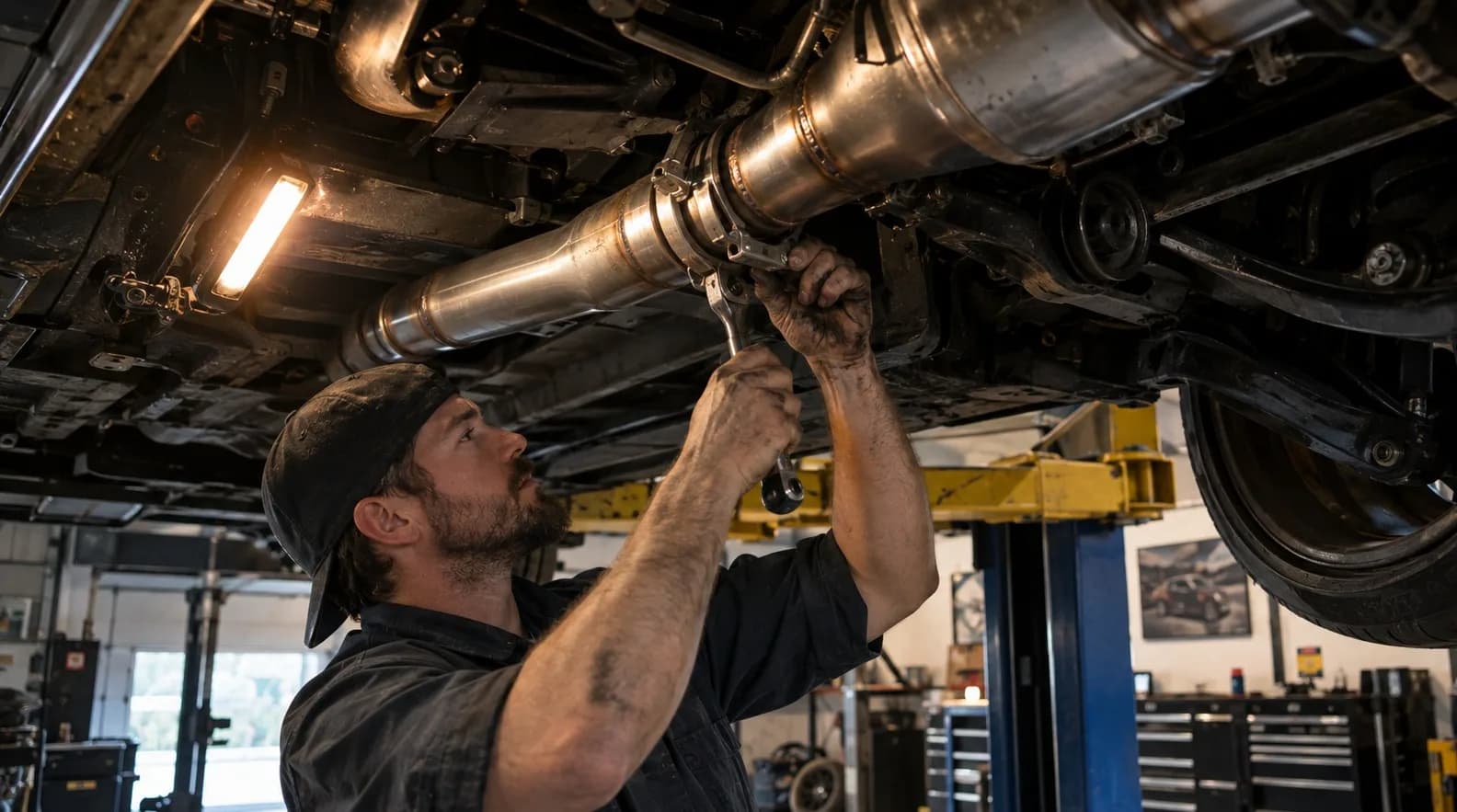
2. Downpipes and High-Flow Catalytic Converters
If your car leaves the factory with a turbocharger, the single biggest physical restriction is the factory downpipe sitting directly behind the turbine wheel.
Automakers design factory downpipes with dense, four-hundred-cell ceramic catalytic converters placed immediately against the turbo outlet to pass cold-start emissions. Replacing this bottleneck with a mandrel-bent, high-flow catalytic downpipe reduces backpressure dramatically.
The turbo spools hundreds of RPM earlier, exhaust gas temperatures plummet, and the engine breathes freely across the top end. On almost any turbo platform, this is where actual double-digit power gains live.
3. Upgraded Charge Air Coolers (Intercoolers)
Factory intercoolers are designed to handle one or two brief pulls before heat-soaking. Once that factory aluminum core absorbs heat from the turbo, intake air temperatures spike, the ECU pulls timing, and your third consecutive pull produces thirty less horsepower than your first.
An upgraded bar-and-plate intercooler does not necessarily add power on pull number one. What it does is preserve your power on pulls two, five, and ten. If you run your car at track days or back-to-back drag events, an upgraded intercooler is not an option; it is a mechanical requirement.
4. Long-Tube Headers (Naturally Aspirated Platforms)
If you drive a naturally aspirated domestic V8 or a high-revving six, a set of equal-length long-tube headers is one of the few physical exhaust modifications that genuinely pays off.
By tuning the primary tube lengths and collector angles, headers use exhaust gas pulses from one firing cylinder to create a scavenging vacuum that pulls spent gases out of the next cylinder in the sequence. That scavenging effect improves cylinder filling and translates directly into usable mid-range torque.
The Chassis Trap: Power You Cannot Put Down
Modifying an engine without touching the chassis is like putting running shoes on a draft horse.
Before spending three grand chasing thirty crank horsepower, ask yourself a simple question: what is your current limiting factor? If you stomp the throttle in second gear and your traction control light blinks on the instrument cluster, adding twenty horsepower will not make you faster. It will simply make you spin longer.
A set of high-performance 200-treadwear street tires, stiffer rear subframe bushings to eliminate wheel hop, and upgraded brake pads with higher heat thresholds will consistently drop your track times faster than any shiny intake tube ever will.
Build the car from the ground up:
Tires and Alignment: Put maximum rubber footprint on the pavement.
Braking Capacity: Ensure you can shed heat repeatedly without pedal fade.
Chassis Rigidity: Control suspension geometry changes under heavy load.
Power Upgrades: Add horsepower only after the car can reliably deploy it.
Stop buying parts to impress the parking lot crowd. Choose upgrades that solve actual bottlenecks, back them up with proper tuning, and build a machine that performs on the stopwatch.
Join CarCultureHQ
Claim your free digital garage
Build your ride profile, log modifications, join a crew, and get your build in front of thousands of enthusiasts.
Create your free garageFrequently asked questions
Do cold air intakes require a custom tune?
Many modern cars measure incoming air mass through sensitive mass airflow (MAF) sensors. If the aftermarket intake tube diameter differs even slightly from the factory housing, it skews the sensor calibration, causing the car to run lean or trigger a check engine light. A tune ensures accurate fuel delivery.
Why do turbo cars gain more from bolt-ons than naturally aspirated cars?
Turbocharged engines use forced induction, meaning any reduction in intake or exhaust backpressure directly improves turbocharger efficiency and spool time. On naturally aspirated engines, the volume of air drawn into the cylinders is strictly limited by atmospheric pressure and engine displacement.
Will a cat-back exhaust void my vehicle warranty?
Under federal law (the Magnuson-Moss Warranty Act), a manufacturer cannot void your entire warranty simply because you installed an aftermarket cat-back exhaust. However, if that exhaust damages another component or causes clearance issues, warranty coverage for those specific damaged parts can be denied.
What is the single best first modification for a stock performance car?
Tires. High-performance summer compound tires improve acceleration traction, shorten braking distances, and dramatically increase cornering grip without compromising mechanical engine reliability.


Comments
Join the conversation on Bolt-On Power: Which Upgrades Actually Work and Which Are Just Expensive Noise?. Keep it civil — admins moderate reports.
Loading comments…