The Loudest Era: When Trunk-Mounted Subwoofers and Audio Competitions Dominated Parking Lots
Estimated Reading Time: 7 minutes
Summary: Before massive touchscreen infotainment systems and factory DSPs took over, car audio was defined by trunk-mounted subwoofers, plywood enclosures, and parking lot flex. This article looks back at the golden era of car audio competitions, breaking down the mechanics of low-frequency physics, why modern sound systems killed the DIY car stereo scene, and what builders today can learn from the era of pure, unrefined SPL.
The Loudest Era: When Trunk-Mounted Subwoofers and Audio Competitions Dominated Parking Lots
If you spent any time hanging around strip malls or gas stations in the late nineties and early 2000s, you heard the era before you saw it.
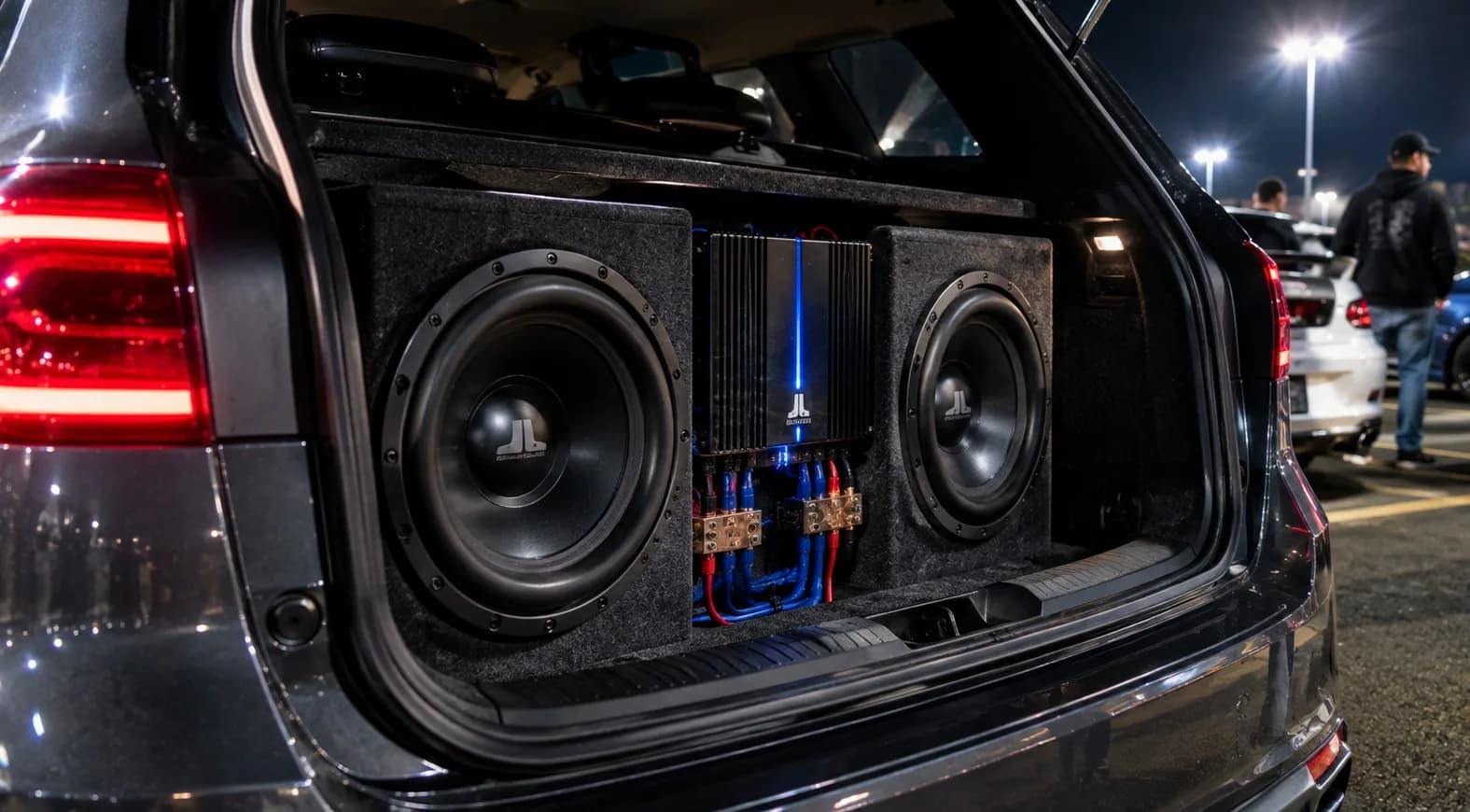
Long before cars came equipped with digital signal processors or thirty-speaker factory sound systems, car audio was a localized contact sport. You felt the bass in your sternum from two blocks away. Trunk lids rattled, license plates buzzed like angry hornets, and rear-view mirrors vibrated until they dropped off the windshield glass.
It was the golden age of trunk-mounted subwoofers and car audio competitions. Back then, nobody bought a car for its infotainment screen. You bought a vehicle, pulled out the factory head unit on day one, and spent your weekends running four-gauge power wire through your firewall until your knuckles were bleeding.
Here is how a generation of car enthusiasts turned vehicle interiors into pressure chambers, why that culture vanished, and what it actually takes to build low-frequency audio that hits hard without blowing your electrical system to pieces.
Join CarCultureHQ
Claim your free digital garage
Build your ride profile, log modifications, join a crew, and get your build in front of thousands of enthusiasts.
Create your free garage1. The Anatomy of the Parking Lot Demo
In 1999, the parking lot behind the local strip mall was an open-air acoustic lab. You had guys crammed into civic hatchbacks and single-cab pickups, running dual fifteen-inch subs off amplifiers that drew more current than a residential air conditioner.
The metric of success was simple: sound pressure level (SPL).
Organizations like USACi and dB Drag Racing turned noise into a sanctioned sport. Decibel meters were clamped to the inside of windshields to measure raw acoustic pressure. People were not listening to acoustic jazz; they were playing test tones, chopped-and-screwed bass tracks, and sine waves designed to hit the resonant frequency of a vehicle frame.
To break 150 decibels, you did not just buy off-the-shelf gear. You built custom ported boxes out of three-quarter-inch medium-density fiberboard (MDF), double-baffled the front face, and sealed every corner with fiberglass resin. If your box flexed under load, you lost decibels. If your trunk seal leaked, you lost decibels.
2. Why the DIY Car Stereo Scene Faded Away
Walk into any dealership today and pop the hood or look at the dash. The days of swapping a head unit in twenty minutes with a wire harness adapter and a dash kit are long gone.
Three main shifts killed the classic trunk-sub culture:
Integrated Vehicle Electronics
In the peak era, a head unit did one thing: output an analog signal to an amplifier via RCA cables. Today, the main screen controls your HVAC system, safety sensors, vehicle settings, and backup camera. Pulling the head unit breaks the vehicle's internal computer communication (CAN-bus).
Factory Audio Optimization
Car manufacturers realized sound sells vehicles. Systems tuned by brands like Harman Kardon, Bose, or Bang & Olufsen use active noise cancellation and digital processing to make small speakers sound punchy. It is clean, but it lacks the visceral, wall-shaking depth of dedicated subwoofers.
The Shift in Car Culture Priority
Enthusiast attention shifted toward vehicle connectivity, track performance, and styling. The raw, loud, mechanical DIY ethos of packing three hundred pounds of wood and magnet weight into a hatch lost ground to lighter, more practical daily drivers.
3. The Physics of Low-Frequency Audio: What Actually Worked
Building serious bass was never as easy as dropping a box into a trunk and turning the gain knob to max. The guys who won trophies understood vehicle acoustics and electrical delivery.
Cone Area vs. Power
A common mistake was throwing a two-thousand-watt amplifier at a single ten-inch subwoofer and expecting it to shake the street. Air displacement is a function of surface area and excursion. Two twelve-inch subwoofers running on five hundred watts will almost always move more air and sound fuller than a single ten-inch sub pushed to its thermal limit on double the power.
Sealed vs. Ported Enclosures
The box dictates the sound far more than the brand logo on the speaker cone.
Sealed Enclosures: Compact, tight, and accurate. They offer predictable roll-off and flat frequency response across acoustic genres, making them ideal for sound quality (SQ) builds.
Ported (Vented) Enclosures: Larger, louder, and tuned to a specific port frequency. A properly tuned ported box yields a three-to-six decibel boost around its tuning frequency, making it the choice for pure SPL.
Sound Deadening Is Not Optional
If your trunklid sounds like a tin can full of marbles, you are wasting acoustic energy. Sound pressure that vibrates loose sheet metal is energy that never reaches your ears.
Applying butyl-rubber deadening mats (like Dynamat or Hushmat) to inner door skins, floorboards, and trunk lids lowers the resonant frequency of the metal. It stops metal vibration, cleans up bass response, and keeps the energy inside the cabin where it belongs.
4. The Electrical Reality: Protecting Your Alternator
When you add high-output subwoofers to a vehicle, your factory charging system becomes the primary bottleneck. A standard stock alternator is designed to run your headlights, ECU, and blower motor, leaving very little headroom for aftermarket electronics.
If your headlights dim every time the bass hits, your amplifier is starving for voltage. Running an amplifier at low voltage causes it to draw more current, generating excessive heat that leads to clipping and burnt voice coils.
If you are building a system today, follow the classic Big Three Upgrade:
Engine Block to Chassis Ground: Replace the thin factory ground strap with 1/0-gauge oxygen-free copper (OFC) wire.
Battery Negative to Chassis Ground: Run a heavy 1/0-gauge ground cable from the battery post directly to clean, bare chassis metal.
Alternator Positive to Battery Positive: Upgrade the main charging lead from the alternator output stud straight to the positive battery terminal with fused 1/0 cable.
For systems exceeding one thousand watts RMS, add an AGM or lithium secondary battery near the amplifier, and step up to a high-output aftermarket alternator rated for 200+ amps.
5. Building for Sound Today
The era of trunk-mounted wall-to-wall subwoofers may be a niche memory, but the principles of good audio design remain unchanged. You do not need to tear out your modern dash or ruin your daily usability to get real low-end performance.
Modern digital signal processors (DSPs) allow builders to tap into factory head unit signals, strip out factory EQ curves, and send pristine audio to high-efficiency Class-D amplifiers. Compact, high-excursion shallow-mount subwoofers can fit under seats or inside spare tire wells without sacrificing trunk space.
You can still have the impact, clarity, and depth of the classic audio era without shaking your car to pieces. Respect the physics, feed your system clean power, and build it to play crisp, not just loud.
Join CarCultureHQ
Claim your free digital garage
Build your ride profile, log modifications, join a crew, and get your build in front of thousands of enthusiasts.
Create your free garageFrequently asked questions
Why did my license plate and trunk rattle so badly in older subwoofer builds?
Low-frequency sound waves cause uninsulated metal panels to flex and vibrate against each other. Installing thick butyl-rubber sound deadening insulation on the interior side of the metal stops panel resonance and cleans up overall bass clarity.
Is a capacitor better than adding a second battery for heavy bass?
No. Standard stiffening capacitors only hold a tiny charge for split-second bursts. If your electrical system suffers from continuous voltage drops, a second AGM battery or high-output alternator provides the sustained current your amplifier needs.
Can I add a subwoofer box to a car with a factory infotainment system?
Yes. You can use a Line Output Converter (LOC) or a Digital Signal Processor (DSP) to take high-level speaker signals from the factory amplifier or door speakers and convert them into clean RCA inputs for an aftermarket bass amp.
What is the difference between peak power and RMS power ratings?
Peak power is a short-burst marketing metric that indicates maximum wattage an audio component can handle for a fraction of a second without instant failure. RMS power measures continuous, real-world power output and handling, which is the only figure you should use when matching amps to subwoofers.


Comments
Join the conversation on The Loudest Era: When Trunk-Mounted Subwoofers and Audio Competitions Dominated Parking Lots. Keep it civil — admins moderate reports.
Loading comments…