Storage Strategies: Preparing Your Vehicle for Long Winter Hibernation
Estimated Reading Time: 7 minutes
Summary: Storing a car over winter requires more than throwing a polyester cover over cold paint and walking away. This guide breaks down the practical realities of vehicle hibernation, covering fuel system stabilization, tire flat-spotting prevention, rodent barriers, and moisture control so your project car fires up in the spring without leaks, dead batteries, or ruined interior leather.
Storage Strategies: Preparing Your Vehicle for Long Winter Hibernation
Parking a car for four or five months sounds simple enough. You wash the body, park it in the back of the garage, lock the doors, and wait for spring.
Then April rolls around. You turn the key, and the starter solenoid just clicks. You pop the hood to jump it and find a nest of chewed vacuum lines on top of the intake manifold. When you finally get the motor firing, the brake pedal sinks straight to the floorboard because condensation pitted the caliper pistons, and the tires thump like square wooden blocks for the first twenty miles down the road.
Putting a performance car or classic build away for the cold months is not passive storage. It is active mechanical preservation.
If you leave volatile fluids, bare metal, and soft rubber sitting motionless in an unheated space, winter will degrade them. Here is how to prep your car for winter hibernation so it hits the road in the spring exactly the way you parked it.
Join CarCultureHQ
Claim your free digital garage
Build your ride profile, log modifications, join a crew, and get your build in front of thousands of enthusiasts.
Create your free garageThe Fuel System: Fighting Ethanol Phase Separation
Modern pump gas is the enemy of stored cars. Most standard unleaded fuel contains up to ten percent ethanol. Ethanol is hygroscopic, meaning it actively pulls moisture directly out of the surrounding air.
When a car sits in a garage through ambient temperature swings, the fuel tank breathes. As moisture accumulates, the water and ethanol bond together and sink to the bottom of the tank. This is phase separation. That stale, watery mixture corrodes steel fuel tanks, gum up injector nozzles, and ruins carburetor jets.
The Fuel Prep Checklist
Fill the tank to ninety-five percent: Leaving minimal air space in the tank reduces internal condensation buildup.
Add a quality stabilizer: Pour in a fuel stabilizer designed for ethanol blends before your final drive of the season.
Run the engine for ten miles: You must circulate the treated fuel through the entire fuel rail, pressure regulator, and injectors. If you just pour stabilizer into the tank and shut the key off immediately, raw, untreated gas remains trapped in the lines all winter.
Protecting the Engine Bay and Driveline
Old engine oil accumulates combustion byproducts, unburnt fuel, and moisture. If you let a car sit for five months with dirty oil in the sump, those mild acids rest against bearing journals and crankshaft surfaces, creating micro-pitting.
Change the oil and filter right before you park the car, even if you only put two thousand miles on the current oil change. Fresh oil coats internal metal surfaces with a clean, protective film that lacks corrosive contaminants.
Battery Maintenance Reality
Do not leave your battery hooked up to the car, and do not rely on cheap knockoff tricklers. A parasitic draw from an alarm light or ECU memory will drain a battery flat in a month. Once a lead-acid battery discharges completely in sub-freezing temperatures, the water inside can freeze, cracking the case and ruining the cells internally.
Best Option: Disconnect the battery entirely, remove it from the car, and store it on a workbench in a climate-controlled space attached to an automatic smart tender.
Second Best: Leave the battery in the vehicle, but disconnect the negative terminal cable and attach a tender with an automatic float mode that cuts off once full charge is reached.
Stopping Rodents Before They Destroy Your Wiring
Mice view a parked project car in an unheated garage as a luxury resort. They chew through expensive wiring harnesses, shred hood insulation for nesting material, and turn heating ducts into food pantries.
To keep rodents out, you need physical barriers rather than scented repellents alone.
Stuff the exhaust and intake: Pack stainless steel wool or brass mesh tight into the exhaust tailpipes and air intake scoop. Mice will not chew through metal mesh. Place a brightly colored ribbon on the steering wheel as a reminder to pull the mesh out before spring startup.
Block floor openings: Inspect the undercarriage and seal open frame holes or missing floor pan grommets.
Ditch the dryer sheets: Essential oils and dryer sheets lose their scent after two weeks in freezing temperatures. Stick to mechanical traps set along the garage walls near the tires.
Tire Care: Avoiding Permanent Flat-Spotting
High-performance summer tires use soft rubber compounds with stiff sidewalls. When those tires support a thirty-five-hundred-pound vehicle on cold concrete in one position for months, the rubber cold-sets.
When you drive off in the spring, you will feel a persistent vibration through the steering wheel that can take fifty miles to warm out, or in worse cases, permanently ruin the tire casing.
How to Prevent Flat Spots
Increase Tire Pressure: Inflate the tires to roughly 38 to 40 PSI (never exceeding the maximum inflation limit printed on the tire sidewall). The extra air helps the carcass maintain its round shape.
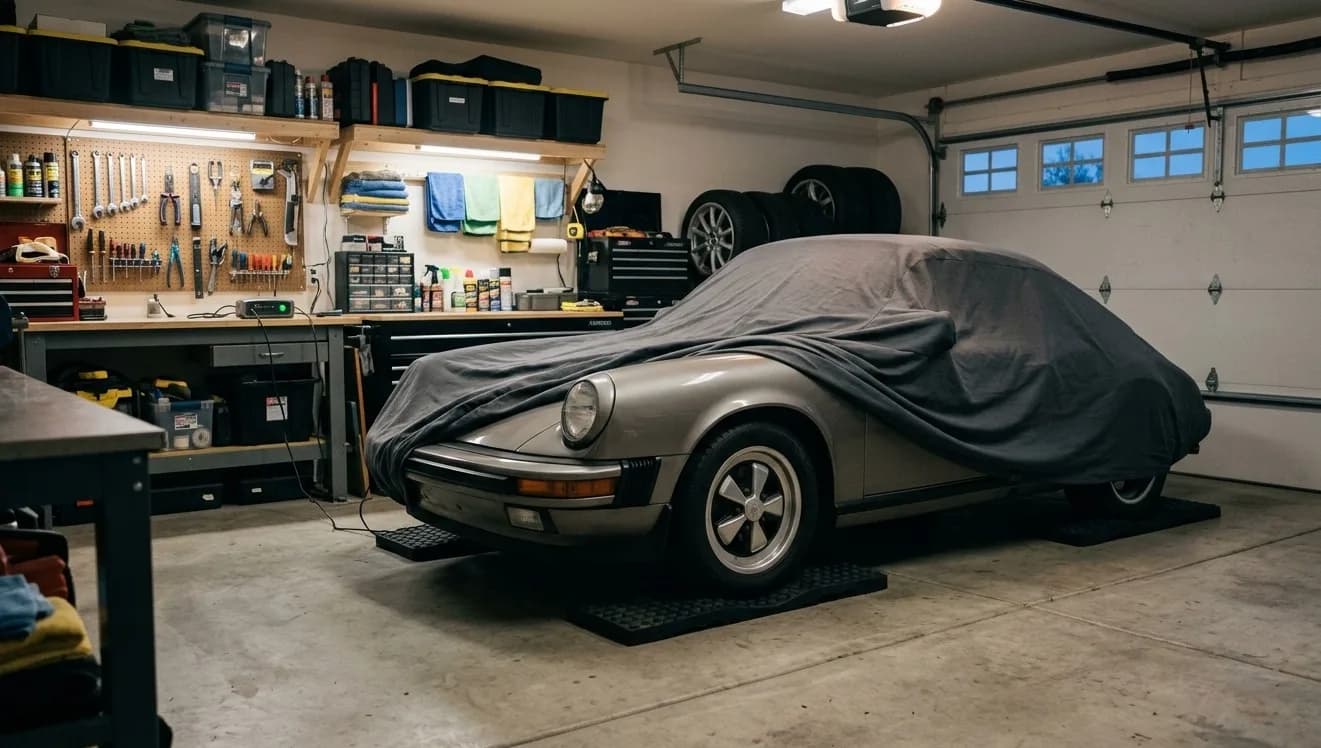
Park on Rubber or Foam: Drive the car onto thick rubber stall mats, dense foam insulation boards, or molded tire cradles. This insulates the rubber from the freezing concrete floor and distributes the weight over a wider curve.
Do Not Jack the Car Up on Suspension Droop: Leaving a car on jack stands with the suspension hanging at full droop puts artificial stress on rubber bushings and leaves shock absorber shafts exposed to moisture and rust. If you lift the vehicle, place the stands directly under the lower control arms or solid axles so the suspension stays compressed at ride height.
Interior Moisture and Paint Care
Before you throw a cover over the car, give the paint a thorough wash and paint decontamination. Dust and road grit left on the clear coat act like sandpaper if the cover shifts or moves over time.
Never use a plastic tarp or a waterproof vinyl cover on a car stored outdoors or in an unheated garage. Plastic traps rising ground moisture underneath, creating a greenhouse effect that blisters clear coats, rusts brake rotors, and mildews interior upholstery.
Indoor Storage: Use a breathable cotton or microfiber car cover that allows trapped moisture to evaporate.
Moisture Control: Place two or three refillable desiccant tubs (like DampRid) on the floorboards inside the cabin and in the trunk to absorb ambient air humidity.
Window Position: Crack the side windows a quarter of an inch to allow air circulation, provided the garage is rodent-free.
Taking these extra steps in the fall turns spring prep from a frustrating repair job into a ten-minute routine. Throw the battery in, pull the exhaust plugs, check your fluid levels, and enjoy the first drive of the season without unexpected surprises.
Join CarCultureHQ
Claim your free digital garage
Build your ride profile, log modifications, join a crew, and get your build in front of thousands of enthusiasts.
Create your free garageFrequently asked questions
Should I start my car once a month during winter storage?
No. Starting a engine in a cold garage for ten minutes without driving it under load generates moisture inside the crankcase and exhaust system that never gets hot enough to burn off. This causes condensation buildup in the oil. Leave the car shut down until you are ready to drive it for a full heat cycle in the spring.
Is it better to store a car with an empty or full gas tank?
A full gas tank is much better. An empty tank leaves large interior surface areas exposed to moist air, causing condensation to form on the tank walls and accelerating fuel system contamination.
What pressure should I pump my tires up to for winter storage?
Increase your tire pressure to around 38 to 40 PSI, keeping it below the maximum cold inflation limit stamped on the tire sidewall. This extra structural support prevents the tread carcass from flat-spotting on the floor.
Do indoor car covers really matter if the car is inside a closed garage?
Yes. A breathable indoor cover keeps fine dust, floating shop debris, and concrete powder off your clear coat while allowing moisture to escape so it does not sweat onto the paint.

Comments
Join the conversation on Storage Strategies: Preparing Your Vehicle for Long Winter Hibernation. Keep it civil — admins moderate reports.
Loading comments…