Factory Horsepower Wars: Wrenching on the Modern Muscle Revival
Written and reviewed by the CarCultureHQ Editorial Team. See our Editorial Policy for sourcing and corrections.
Estimated Read Time: 13 minutes
Summary: Forget the generic history. We are not talking about "culture" today. We are talking about the technical choices that actually matter from the modern muscle car era. Pushing past 400 horsepower became common not through magic, but because of specific shifts in engine architecture, accessible supercharging, and modern engine management. If you’re wrenching on one of these cars now, or thinking about buying one, here is the no-hype, technical breakdown of what the modern factory horsepower wars actually delivered.
The Garage Discussion We Are Having
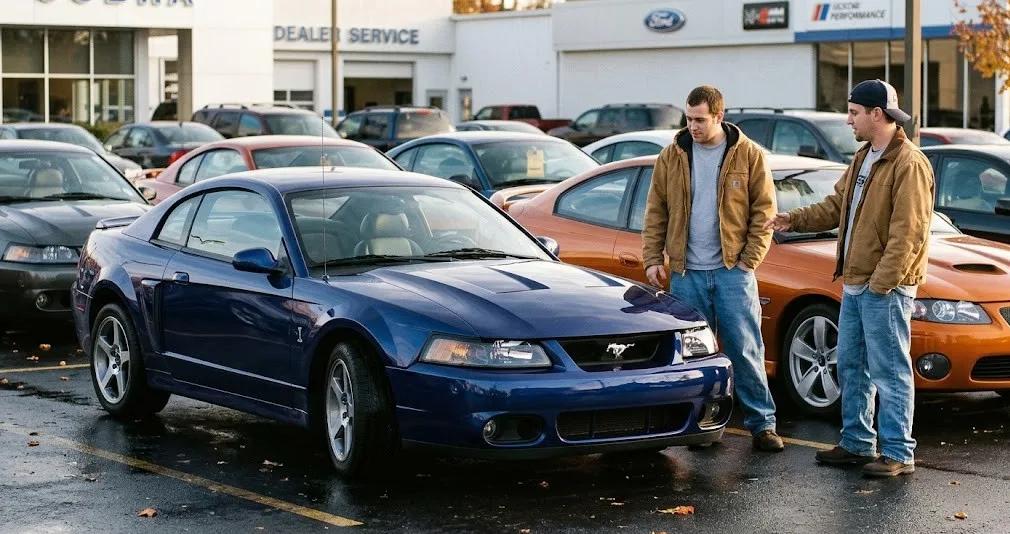
If you look at some glossy magazine retrospective, they will talk about the Challenger’s retro styling or the Mustang’s "return to form." Ignore all that. I was in a dealership garage when the 2003 Cobra, the "Terminator," showed up.
Nobody cared about styling. We were looking at a factory DOHC (Dual Overhead Cam) Modular engine, but Ford had finally built the damn thing right: forged pistons, Manley rods, and a literal factory supercharger bolted to the top. This car single-handedly restarted the modern factory horsepower wars by proving that you could have reliable, 390 (but actually 420+) horsepower daily-driver power.
If you are looking at buying or wrenching on a car from this era (roughly 2003-2012), forget the standard history lesson. Here is the technical reality of what that competition built.
Join CarCultureHQ
Claim your free digital garage
Build your ride profile, log modifications, join a crew, and get your build in front of thousands of enthusiasts.
Create your free garageThe Technical Fight: DOHC vs. Pushrod (Wait, This Still Matters?)
The biggest fight of the modern muscle revival was a philosophical engine architecture battle. For 30 years, it was displacement or death. The rule was: there is no substitute for cubic inches.
That rule got murdered by modern engine management and factory supercharging.
The modern factory horsepower wars split into two technical camps, and which one you choose to build in your garage completely dictates how you build power.
Camp 1: The Modern Modular Revolution (DOHC and Small Displacement)
Ford bet everything on the Modular V8. It was a complex, wide, 4.6-liter (and later 5.4L/5.8L/5.0L) DOHC engine. From the factory, those early N/A (Naturally Aspirated) ones were... fine. But complex. When Ford decided to restart the wars, they didn’t try to increase displacement. They used efficiency.
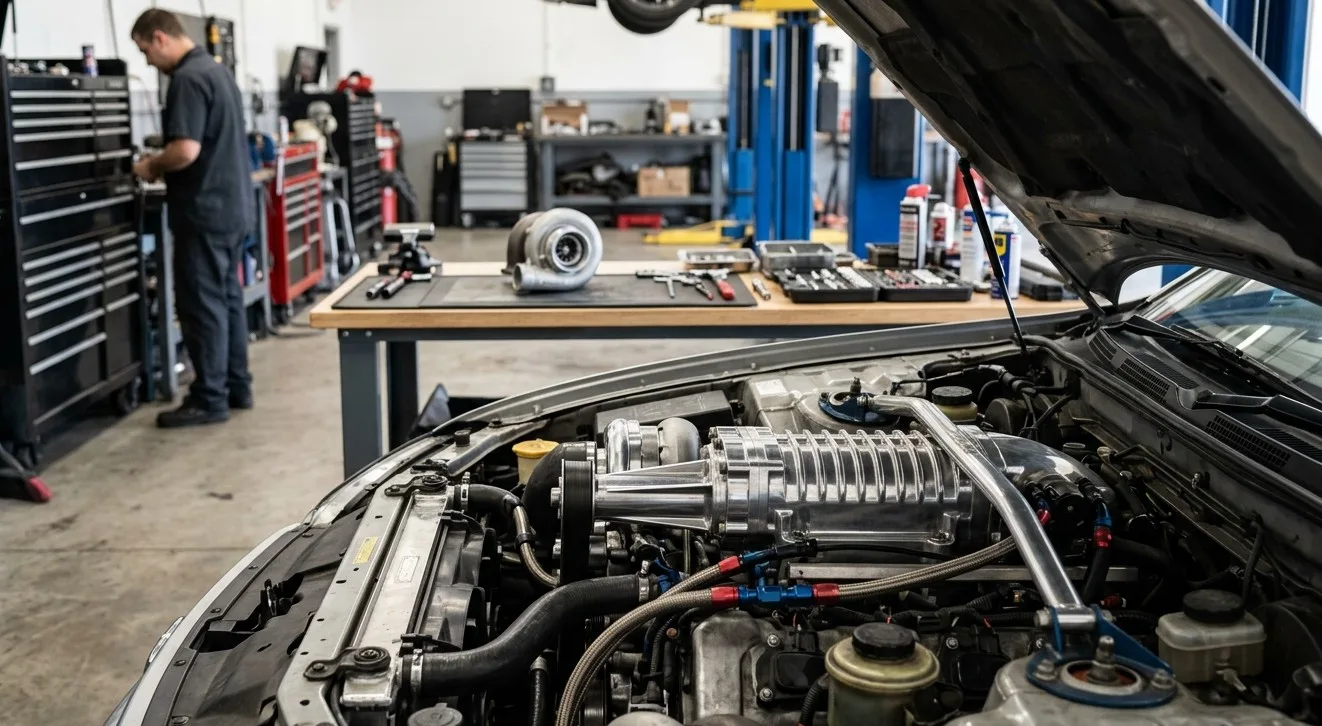
They used DOHC: 4 valves per cylinder. More valve area meant the engine breathed efficiently at high RPM. DOHC prioritized high-RPM power and mechanical efficiency over raw cubic inches. Then, they stabilized it with a factory supercharger (the Eaton M112 on the Terminator).
CCHQ Perspective: This architecture is optimized for boost. If you want a small-displacement car that makes 700+ horsepower and screams at 7,500 RPM, this is your path. The drawback? The Modular engine is physically huge, complex to rebuild, and parts are often expensive because of the DOHC overhead.
Camp 2: The Optimized Traditionalist (The LS and the Hemi)
GM and Chrysler looked at the Modular engine and stuck with pushrods. They recognized the pushrod V8 was simpler, more compact, and cheaper to build. They optimized it.
The GM LS series was brilliant not because it was groundbreaking, but because it was optimized: aluminum blocks (on many models), simplified wiring, modern oiling, and massive displacement. A 5.7-liter LS1 (GTO) made 350 horsepower naturally aspirated, all day long. When Dodge brought back the 5.7L Hemi (Challenger), they proved that the pushrod V8 could still deliver 400+ NA horsepower with basic performance architecture.
CCHQ Perspective: This is your path for torque and simplicity. An LS or a new-gen Hemi engine architecture is optimized for raw torque and simplicity. The aftermarket support is so large (the "LS Swap") that building these engines is a massive exercise in accessible power. Parts are everywhere, and knowledge is common.
The Real Power Tool: The Modern ECU
We talk about blocks, cranks, and blowers, but the real champion of the modern factory horsepower wars was modern engine management.
Old muscle cars (pre-1996 OBDII) ran on "set it and forget it" parameters. If you added performance parts or ran bad fuel, the engine couldn't adjust; it just knocked and potentially destroyed itself. Modern ECUs are real-time, high-fidelity computers.
This was the technical key that allowed the standard performance boundaries to be shattered:
High Compression and Boost: Modern management allowed engines (like the newer 5.0L Coyote or GM LSA) to run high static compression ratios and still handle significant boost pressure reliably.
Adaptive Calibration: Modern ECUs constant monitor air/fuel ratios (via wideband oxygen sensors) and individual cylinder knock. If you run 87 octane, the ECU detects the knock instantly and retards timing to protect the engine. This reliability made 500+ factory horsepower standard.
Tuning Accessibility: Companies like HP Tuners and Cobb Tuning unlocked these complex factory parameters. For the first time, a garage mechanic could safely and precisely calibrate their own setup on a dyno. This software accessibility was a defining part of the factory horsepower wars; the cars with the most hackable ECUs saw the most aftermarket development.
CCHQ Final Garage Verdict: Buy the Foundation, Not the Number
If you are looking at a modern muscle revival car, ignore the standard metrics. Forget the 0-60 times. Forget the factory-rated horsepower.
The only thing that matters from this era is the chassis foundation. You can always build power; you cannot easily add suspension geometry.
When you look at a car, check its underlying technology:
IRS vs. Solid Axle: This is the real performance boundary line (image_8.png). The 2003-2004 Terminator Cobra, the Pontiac GTO, and the modern Challenger/Charger all use independent rear suspension. These cars can handle turns. They are complex and more difficult to launch, but they are proper chassis setups.
Built Internals: Some standard models had built internals. The Terminator Cobra did. That specific 4.6L shortblock was built to handle 1,000+ horsepower. A standard GT Mustang did not. You are looking for a built foundation (Manley rods, forged pistons) before you can ever worry about boost.
Accessible Aftermarket: If you want easy 500+ wheel horsepower, buy an LS-swapped car or a built, boosted Ford. The accessibility of parts is the final performance ceiling.
The modern factory horsepower wars didn't give us good styling; it gave us a massive, affordable toolkit. Get in the garage and build something with it.
Join CarCultureHQ
Claim your free digital garage
Build your ride profile, log modifications, join a crew, and get your build in front of thousands of enthusiasts.
Create your free garageFrequently asked questions
Is a Terminator Cobra a better project car than a 2011+ Coyote Mustang?
They are completely different mechanical beasts. The Terminator (03/04 Cobra) uses a built-internals DOHC Modular 4.6L specifically engineered to handle massive boost pressure (image_8.png). It has an unique chassis (Independent Rear Suspension) but uses older hydraulic steering geometry. The 2011+ Coyote is a much more technologically advanced 5.0L DOHC engine. It makes better N/A power, has variable cam timing (Ti-VCT), and uses a modern electric steering setup. However, standard Coyote blocks are not built-internals and cannot handle the same raw boost pressure as a standard Terminator shortblock. If you want a raw, dedicated boost build, pick the Terminator. If you want a balanced, refined daily driver, the Coyote is better.
Why is the Pontiac GTO often overlooked in modern muscle retroperspectives?
It was too focused on performance, not styling. The GTO (2004-2006) had excellent technical architecture: an IRS chassis, a Tremec T56 transmission, and optimized LS engines (LS1/LS2). It drove better than the solid-axle Mustang. But the styling looked like a rental car, not a performance legend. It had zero "muscle" aesthetics. In this hobby, styling drives standard desirability. The GTO’s value is its secret mechanical technology.
What is tramlining, and why is it worse on wider modern performance cars?
Tramlining (also called "snaking" or "groove wandering") is when your car’s front tires want to follow the ruts, grooves, and expansion joints worn into the asphalt. Because wider modern performance wheels and high-performance tires (often running significant negative camber) have a wider contact patch, they provide more leverage for road ruts to pull the steering wheel (image_8.png). It is not a geometry defect; it is a mechanical trade-off for having more cornering grip. To minimize it, prioritize fresh tires and a precise, performance alignment specification rather than generic factory specs.

Comments
Join the conversation on Factory Horsepower Wars: Wrenching on the Modern Muscle Revival. Keep it civil — admins moderate reports.
Loading comments…